‘It’s the thought that counts’: Esther’s gift to Susan Herbert

It was a brilliant match – seventeen-year-old Susan de Vere married Philip Herbert, soon to be Earl of Montgomery, on 27 December 1604. The young couple had contracted to each other in secret, but King James himself took up their cause and gave away the bride during the lavish court festivities that included a masque (now lost) Juno and Hymenaeus. Lady Susan was one of the daughters of Edward de Vere, Earl of Oxford, but she had been raised in the household of William Cecil, Lord Burghley, with all the advantages and wealth.  She had recently joined the court of Queen Anna, and maintained a close relationship with both princes Henry and Charles. 

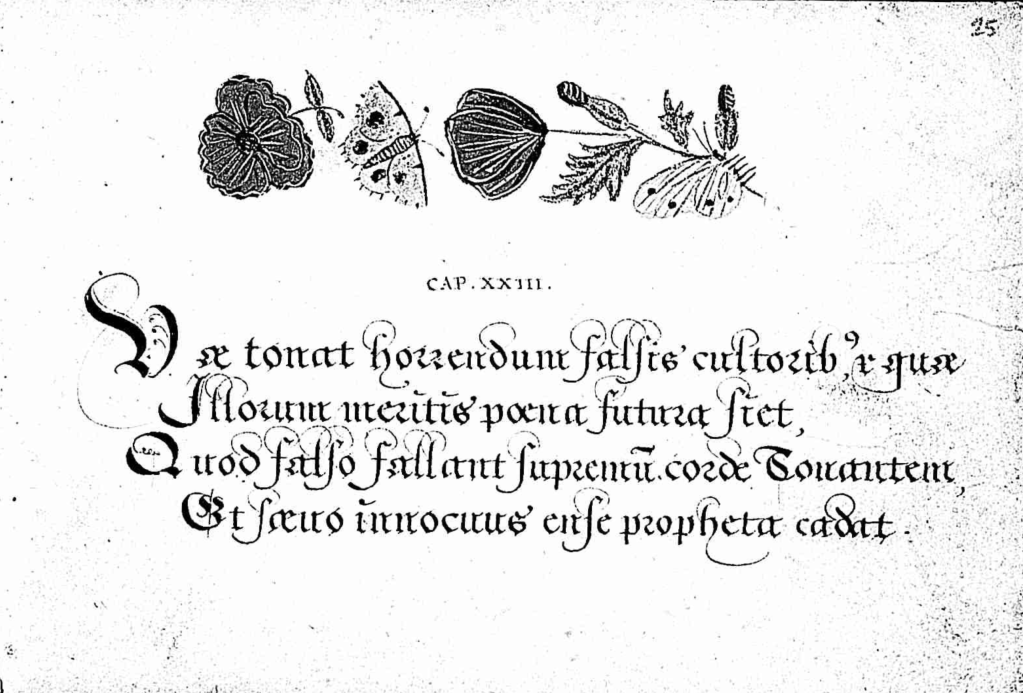
Esther must have heard of this marriage, perhaps through her friend David Murray in Prince Henry’s household, and she presented a manuscript to Lady Susan on 20 February 1605. Alas, if only she had been better prepared. The gift was not one of the glorious coloured manuscripts full of flowers and insects, or even one of the amazingly decorated black-and-white manuscripts, but her plain calligraphic copy book, probably dating from 1586. 

Harvard, Houghton Library, MS Typ 428.1 Seq 5

Writing about this now, makes me feel a little embarrassed for Esther.  Having moved to London in mid-1604, then copied out David Hume’s treatise on British union, she apparently had not had time to create something special. And that was a shame, since Susan Herbert loved the arts, danced in many of the Queen’s masques, and became a noted patron to a number of writers. What she thought of Esther’s little book, we’ll never know.

Harvard, Houghton Library, MS Typ 428.1 Seq 3 – Dedication

Perhaps at least she appreciated the dedication in which Esther writes: ‘. . . albeit I be a stranger and no way knowen to your L[adyship], yitt haue I tane the boldnes to present you with thir few flovris that I have collected of Dame FLORAS blossomes Trusting your L will accept heirof als kindlie as from my heart I haue done it, and in humilitie offers the same to your L. and the rather becaus it is the work of a woman of one, desyrous to serue and honour your L, in any thinge it shall please your L, to command’.

Lady Susan had a superior education in the Cecil household, which likely included a writing master. If she looked through Esther’s book with its forty different calligraphic hands, she might have been reminded of her own studies, though she would not have reached Esther’s professional proficiency.

Harvard, Houghton Library, MS Typ 428.1 Seq 49

Harvard, Houghton Library, MS Typ 428.1 Seq 71

At the end of the dedication, Esther hopes her little work will be agreeable to Lady Susan, and shows her knowledge of the recent wedding when she says, ‘I pray God blis and preserue your L, and your noble husband in long life, good health and prosperitie.  At London this xx of Februar 1605’.

Later in 1605, Esther began producing a string of beautiful, coloured manuscripts, for Robert Sidney, Earl of Leicester; Lucy, Countess of Bedford; and Elizabeth, Lady Erskine, among many others. If she had had such a one available, who knows whether she would have gained a genuine patroness in Susan de Vere Herbert, soon to be Countess of Montgomery.

‘Grizzle Nimmo aught’ the Earl of Morton’s Book

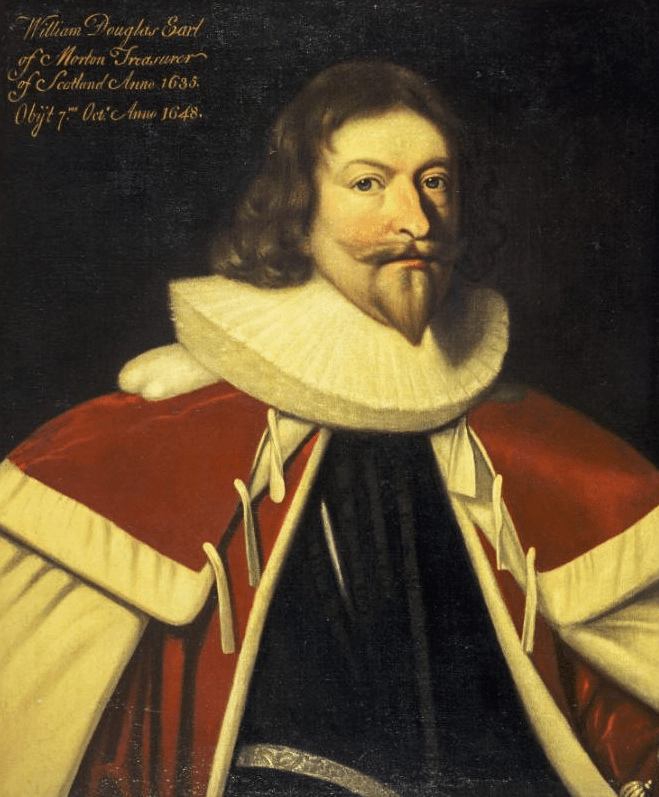
On 26 January 1607, Esther Inglis presented a copy of Gwalther’s Latin verse summary of the Gospel of Matthew “To the Right Honorable and Most Noble Lord, William Earle of Morton, Lord of Dalkeyth, &C.” At the age of twenty-four, William Douglas had succeeded to his grandfather’s title and become 7th Earl of Morton in November 1606. Two years earlier he had married Lady Anne Keith, daughter of George Keith, fourth earl Marischal (ODNB).  

William Douglas, 7th Earl of Morton, from a painting at Dalmahoy

David Murray, Esther’s “ear” at court, must have told her that Morton was arriving in London where she was residing in 1606.  Esther writes, “sen I hard of yr cumming to this cantrie, I haue bene exercised in perfyting this litle book dedicated to yr Lo:”  She had never met him, but he was obviously an up-and-coming young man from a very distinguished family (Mary Queen of Scots had been kept at his grandfather’s castle Lochleven).  Esther writes: “My Lord, that one vnknown to your Lo: hes emboldned hir selfe to present you with a few grapes of hir collection, I hope your Lo: shal not altogether mislyk therof.”  

Esther also hopes that she won’t “be estemed impudent in transending the limites of scham fastnes (wherwith our sexe is commonlie adorned) in offring this small work of my pen and pensill . . . Beseeching you accept of it and the rather becaus it is a womans work.” This bowing and scraping of course is merely an expected stance, used by both sexes at the time; Esther knows full well the beauty and value of her work.  

Esther Inglis, Argumenta singulorum capitum Evangelii Matthaei Apostoli, 26 January 1607. NLS MS Acc. 11821. Image from Perdita

The 7th Earl went on to become a member of the Scottish Privy Council, and in 1630, Lord High Treasurer of Scotland. We don’t know what he thought of the manuscript; perhaps he passed it on to his wife, Anne. It is certainly beautiful, decorated with Esther’s signature style of a flower-strewn, gold title-page frame, and fine drawings of flowers on each page of text.  In the early eighteenth century, the manuscript passed into the hands of a young woman, Grizel Nimmo (1688-1730).  She noted her ownership several times on the verso of folio 30: “This Book at present doth belong unto me Grisall Nimmo” and “I Grizell Nimmo aught ys Book 1712/ Grishilda Nimmo.” Much information on Grizzell’s family and subsequent owners is filed with the manuscript in the National Library of Scotland.     

Esther Inglis, Argumenta singulorum capitum Evangelii Matthaei Apostoli, 26 January 1607. NLS MS Acc. 11821, fol. 30v. Image from Perdita

The Mysterious “Monseigneur de Hayes”: a 1607 New Year’s Gift

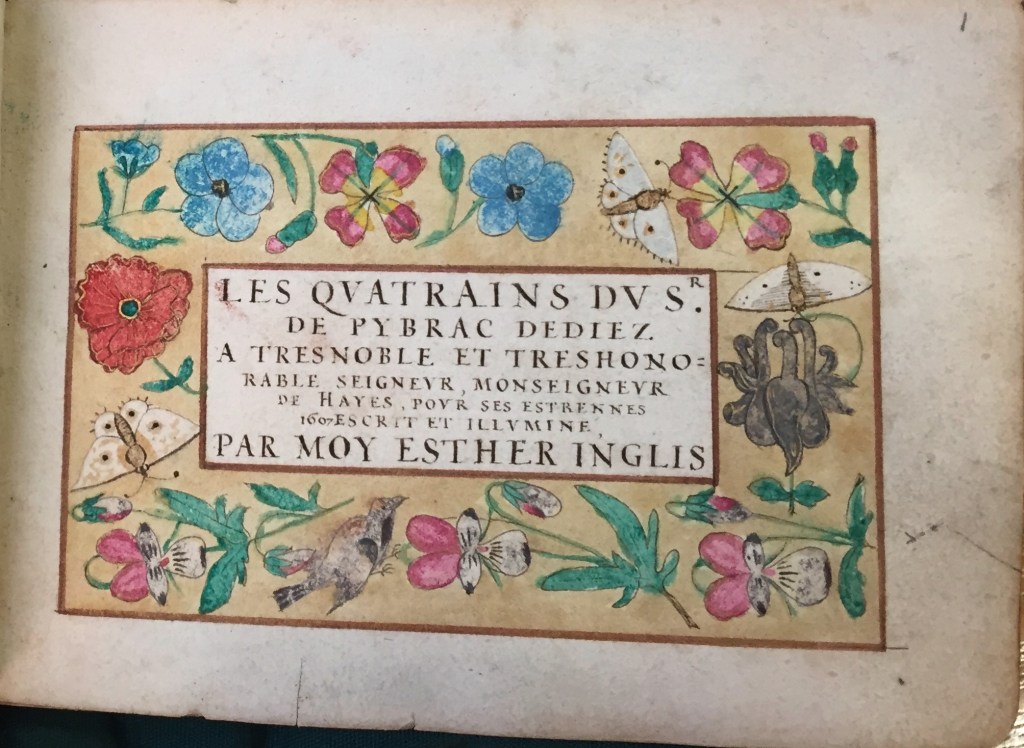
Les Quatrains Du S. De Pybrac Dediez A Tresnoble et Treshonorable Seigneur, Monseigneur de Hayes . . . 1607. Newberry Library Wing MS miniature ZW645.K292 (Photo by G Ziegler)

Esther Inglis gave this beautiful manuscript as a New Year’s gift in 1607 to someone she addressed as M. de Hayes. With no first name to go on, the bibliographers A.H. Scott-Elliot and Elspeth Yeo suggested years ago that he might be Sir Thomas Hayes, who had received a knighthood from King James in 1603 and was to be Lord Mayor of London from 1614-15 (SE/Y no. 31). Somehow, this didn’t exactly make sense in various ways. First of all, Esther and her family were not living in London when Thomas Hayes was Lord Mayor; they had long before moved on to Willingale Spain in Essex. Secondly, the other manuscripts she gifted at this time were for prominent members of the court: Ludowic Stewart, Duke of Lennox; Robert Cecil, Earl of Salisbury; Gilbert Talbot, 7th Earl of Shrewsbury.

Looking through the other courtiers, however, I found James Hay (or Hayes) c.1580-1636, a Scot from Fife, who in 1603 became a member of Queen Anna’s bedchamber and was made Lord Hay in 1604.1 King James liked the man and continued to shower land and honors on him, finally making him a baron in 1606. Part of this beneficence was in the interest of promoting a marriage between Lord Hay and Honora Denny, also a member of the queen’s court, whose father had severe objections to the union.

In the end, Sir Edward Denny came round, and the couple were married at a festive occasion on 3 January 1607. Their wedding was celebrated with a masque specially written by Thomas Campion, known familiarly as “Hayes Masque” and printed soon after it was performed.

This delightful detail of gilded snail and flower is found on fol. 32.

Newberry Library Wing MS miniature ZW645.K292 (Photo by G Ziegler)

Three Very Special 1606 New Year’s Gifts

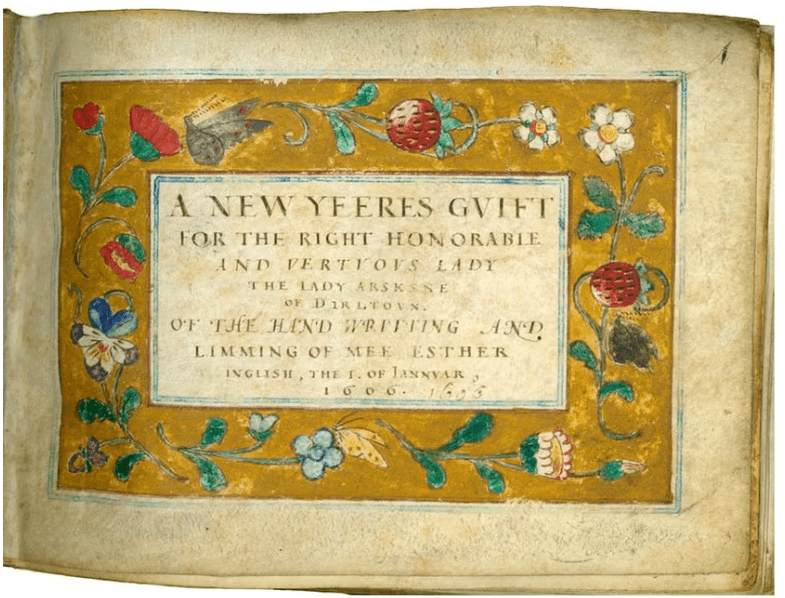
A New Years Guift for the Right Honorable And Virtuous . . . The Lady Erskine of Dirltoun. Newberry Library, Wing MS. miniature ZW 645.K29

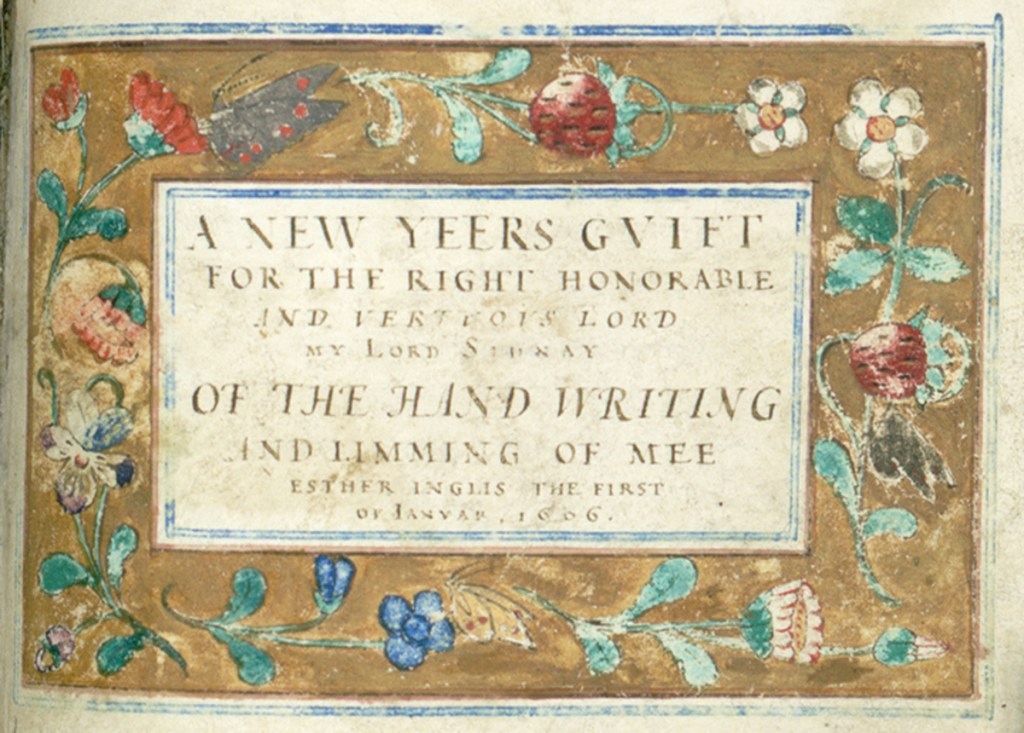
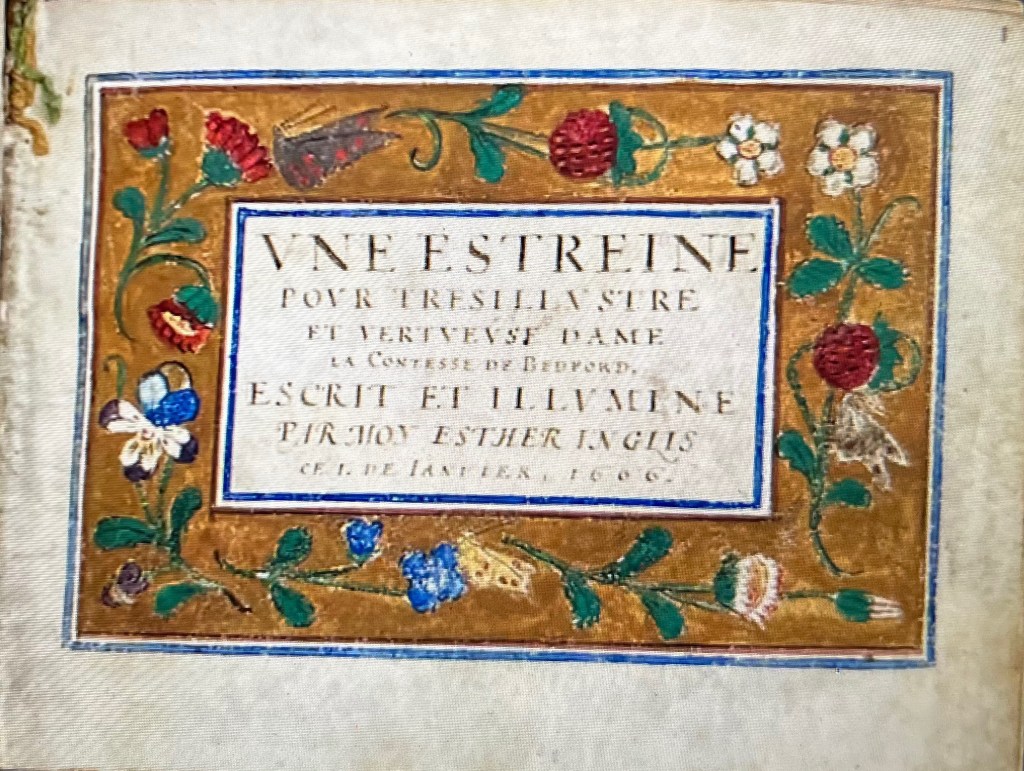
Esther and her family had arrived in London in mid-1604, following the Stewart court. While there, she began experimenting with new materials, working for the first time in full colour and even trying what it was like to paint on vellum. During 1605, in preparation for the following New Year, she made three manuscripts in this medium, which had been widely used in the medieval period, but was now mostly found in special legal and royal documents. The recipients were all connected to the court of James VI/I: Robert Sidney, Earl of Leicester (and younger brother of the lamented Sir Philip Sidney); Lucy Harington Russell, Countess of Bedford (and noted patron of the arts), and Elizabeth Norris, wife of Thomas Erskine, Lord Dirletoun. Elizabeth, whose manuscript is seen above, was one of the wealthy English widows who married a Scottish courtier, matches that were promoted by King James.

A New Yeers Guift For The Right Honorable And Virtuous . . . Lord Sidnay . . . . HRC, Pforzheimer MS 0126

Une Estreine Pour Tresillustre Et Vertueuse Dame La Contesse De Bedford . . . NLS MS Acc. 11624 (Photo courtesy A.N.Pike)

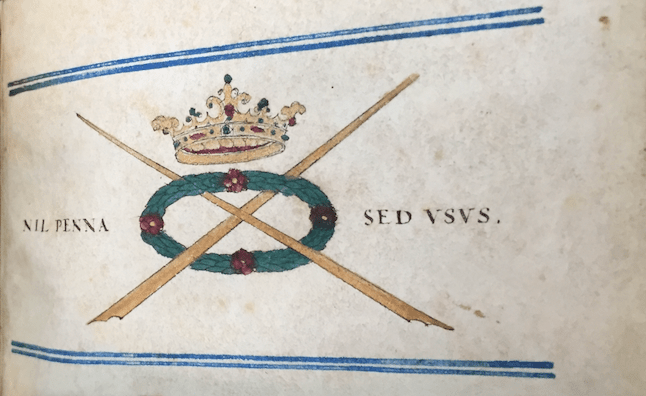
The similarities among these three manuscripts indicate that Esther was streamlining her work, no doubt necessitated by having an infant and three other children needing her attention. All three use texts from the Book of Proverbs. If you compare the title pages, you’ll see that she copies the same patterns of flowers, fruits and moths, and she repeats designs on interior pages as well. All three manuscripts also contain the crossed calligrapher’s pens with the motto Nil Penna Sed Usus (“not the pen itself, but the skill in using it”) which she adapted from a handwriting manual by Jacobus Hondius.

Newberry Library Wing MS ZW 645.K29 (Photo, GZ)

2024 The Year of Esther Inglis!

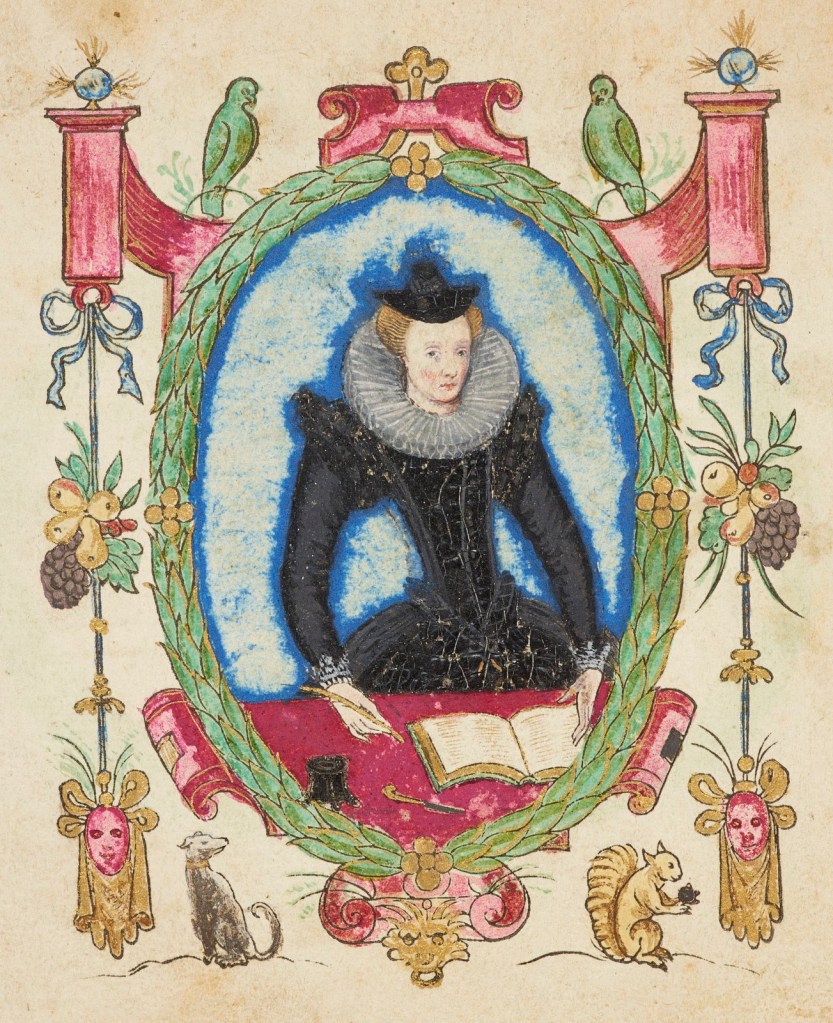
Cinquante Octonaires . . . Dediez a monseigneur le Prince, pour ses étrennes, de l’an, 1607. RCIN 1047001. Royal Library. Windsor.

2024 marks the 400th anniversary of the death of Esther Inglis on 30 August 1624. Throughout the year we’ll be blogging in this space about many of her works on or close to the dates when they originally appeared. We’re beginning with the magnificent self-portrait, in a manuscript dedicated to Prince Henry when he was about thirteen years old. Only four of these full-color portraits are known to survive, all made between 1605 and 1606 when she was living in London and may have been learning from miniature masters, Nicholas Hilliard and Isaac Oliver. The other three manuscripts were given to Christian Friis, Chancellor of Denmark (July 1606), Thomas Egerton, Lord Ellesmere (New Year’s 1606), and Ludovic Stewart, 2nd Duke of Lennox (New Year’s 1607). The copy of Antoine de la Roche Chandieu’s popular Octonaires was a New Year’s gift for Prince Henry in 1607.

Twenty-five of her manuscripts from 1591 to 1624 are dated from January, and nineteen of these are specifically designated 1 January, meant as New Year’s gifts. A list follows below. New Year’s Day was the eighth of the Twelve Days of Christmas, a festive season following the religious commemoration of the Birth of Christ. On this day gifts were traditionally given at court, and many of Inglis’s manuscripts were meant for members of the Stewart court, though her first one for this day was directed to Elizabeth I in 1591.

1591 – Discours de la Foy, Queen Elizabeth I

1606 – Proverbs: Lucy, Countess of Bedford

1606 – Proverbs: Robert Sidney

1606 – Proverbs: Elizabeth, Lady Erskine

1607 – Octonaires: Prince Henry

1607 – Ecclesiastes: Thomas Puckering

1607 – Octonaires: Ludowic Stewart, Duke of Lennox

1607 – Quatrains: Robert Cecil, Earl of Salisbury

1607 – Quatrains: James Hay (later) Earl of Carlisle

1607 – Octonaires: Gilbert Talbot, 7th Earl of Shrewsbury

1608 – Treatise of Preparation to the Holy Supper: David Murray

1608 – Argumentum Psalmorum: Prince Henry

1609 – Book of the Armes of England: Prince Henry

1609 – Octonaries: Lord Petre

1615 – Quatrains: [Lost, dedicatee unknown, Sloan MS 808]

1615 – Quatrains: Prince Charles

1615 – Pseaumes de David: King James VI/I

1615 – Octonaires: Prince Charles

1615 – Quatrains: Robert Kerr, Earl of Somerset

Those dated January but not the 1st:

1607 – Argumenta in librum Psalmorum: Sir Thomas Egerton

1608 – Argumenta in Librum Geneseos: Sir Edward Stanhope

1614 – Quatrains/Octonaires: David Murray

1616 – Octonaires: John Spotiswood, Archbishop of St. Andrews

1622 – Emblematical drawing of Marie Stewart, Countess of Mar for the Earl of Mar

1624 – Emblemes Chrestiens (by Georgette de Montenay): Prince Charles