Women of Many Talents

Calligrapher, limner, embroiderer, writer – those are all arts in which Esther Inglis engaged. She seems to have been unique in Britain at the time, so who were her cohorts?

There must have been other contemporary British women who were multi-talented, but it’s not easy to find them. Certainly upper-class women, including queens Elizabeth and Mary of Scots, learned to embroider and often had handwriting lessons, but they didn’t use their talents professionally.

Mary Queen of Scots monogram. Museum no. T.29-1955. © Victoria and Albert Museum, London

Jane Segar, Enamel on velvet front binding from British Library, Add. MS 10037

Then there was Jane Segar, from an artistic family, who wrote out her own poems on the Sibylls in a beautiful hand, and bound them in a jewel-like enamel binding for Queen Elizabeth, but this work seems to be unique.1

To find really multi-talented professional women artists working on a scale similar to Esther’s we need to turn to the continent, and especially, the Netherlands. Many of them will be found in an exhibition on now (until Jan. 11, 2026) at the National Museum of Women in the Arts: “Women Artists from Antwerp to Amsterdam, 1600-1750.”2

Most of these women were from professional families; some like Esther had a father who was an educator. Often other members of their family were involved in the arts, like Esther’s calligrapher mother Marie Presot, and many were multi-talented. One of the best-known is Anna Maria van Schurman (1607-1678), a scholar, writer and calligrapher who also made drawings, and engraved on copper and glass.
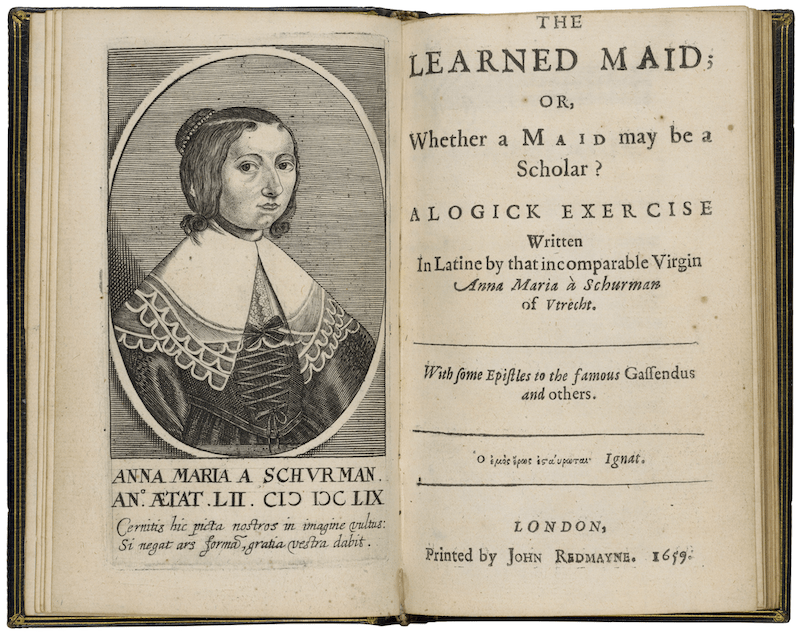
English translation of Schurman’s work, with engraving of her self portrait. First published in Latin in 1641, then in London in 1659. Folger Shakespeare Library.

Then there is Margaretha van Godewijck, known only by reputation, since her works are lost. Her talents were described by Arnold Houbraken in his Great Theatre of Dutch Painters and Paintresses (1718): “She was able to stitch landscapes, farms, houses, flowers and all kinds of ships, as well as paint everyting in oil and water paints. . . She was also able laudably to depict all sorts of objects in pen and pencil, [and] could further write inventively on glass . . . .”[3]

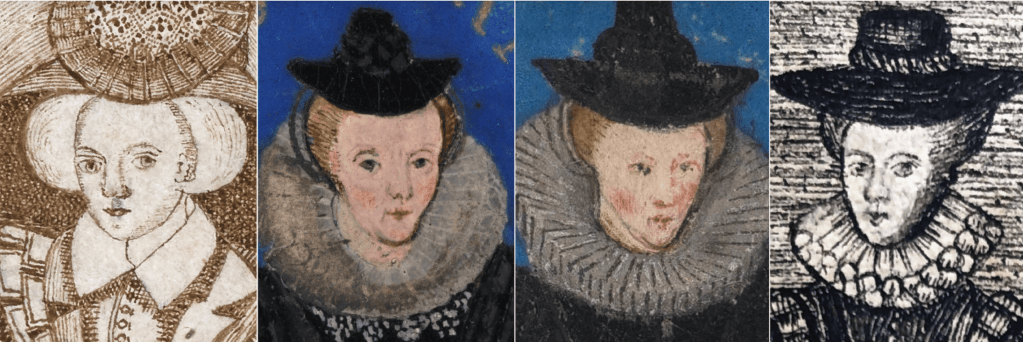
More than 40 versatile women artists—painters, sculptors, embroiderers, lacemakers, printmakers, papercutters—are featured in the exhibition and catalogue, along with self portraits. Esther Inglis was the first woman in Britain to include self portraits with her works, but she had a forerunner in Catharina van Hemessen (1548), the first European artist of either sex to create a self portrait.3 After Hemessen, many other Dutch women artists, including van Schurman and Judith Leyster followed suit.
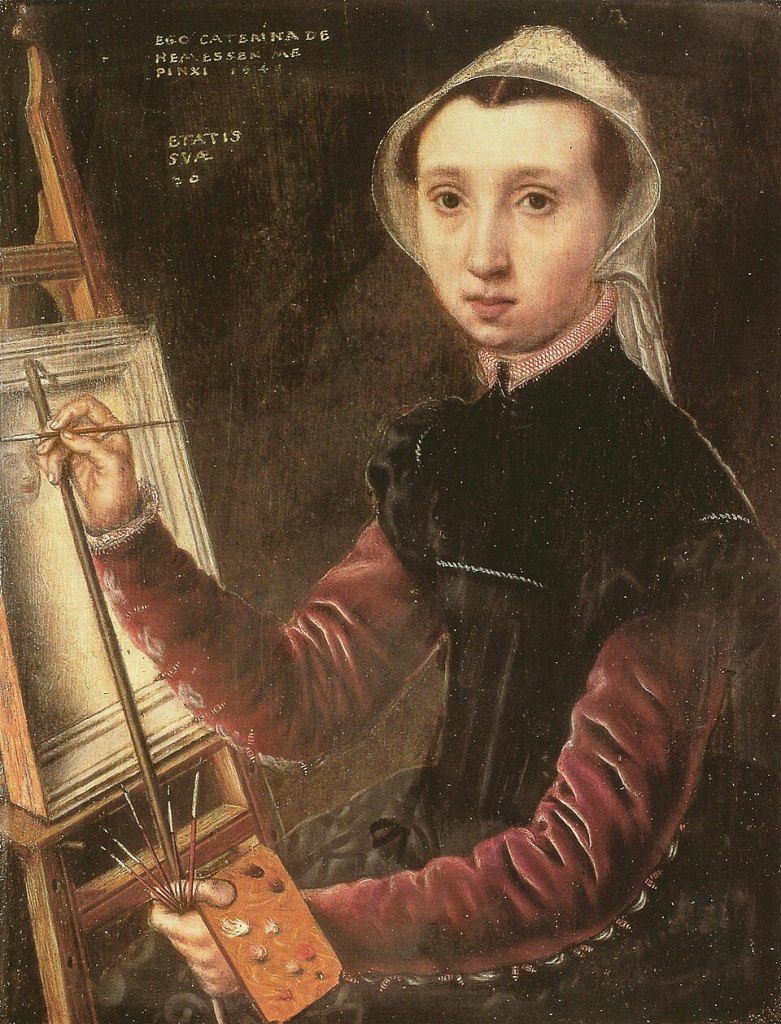
Catherina van Hemessen, Self portrait, 1548. Öffentliche Kunstsammlung, Kunstmuseum, Basel. Dépôt de l’Institut Professeurs Bachofen et J.J. Burckhardt, 1921.

 Like Hemessen, Esther shows herself at work with the tools of her trade: pen, ink, and paper. Schurman never shows her hands actually creating. Apparently she was taken to task for that by Constantijn Huygens, the statesman and poet, who thought she should be proud of her ink-stained hands.4

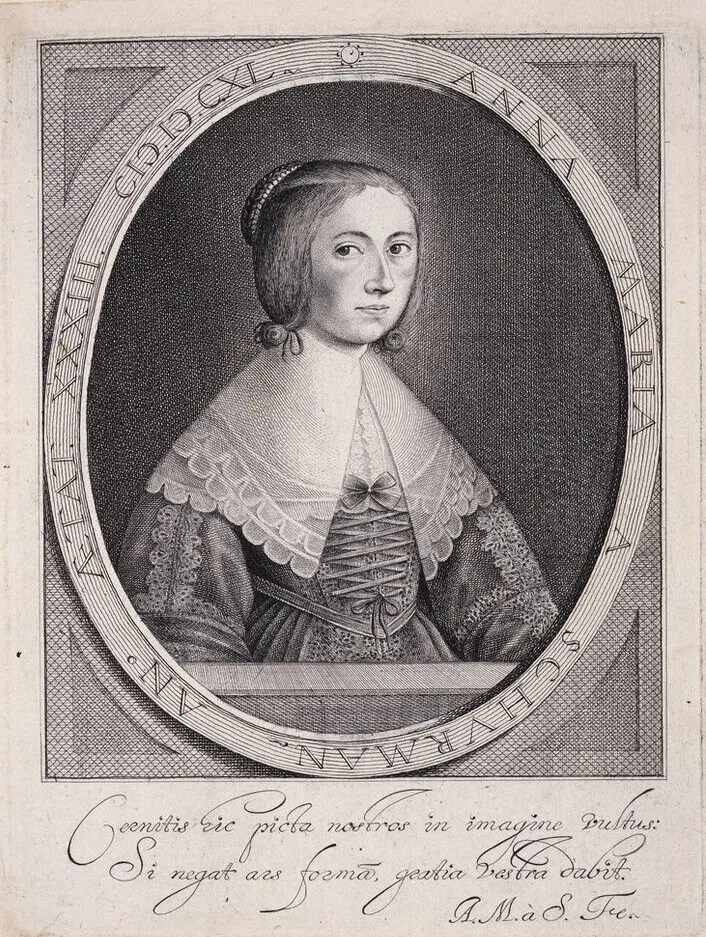
Esther Inglis, Self portrait drawn with pen and ink, 1602 (NLS MS 20498); Schurman, Engraved self portrait, 1640 (NMWA, National Museum of Women in the Arts, Gift of Wallace and Wilhelmina Holladay)

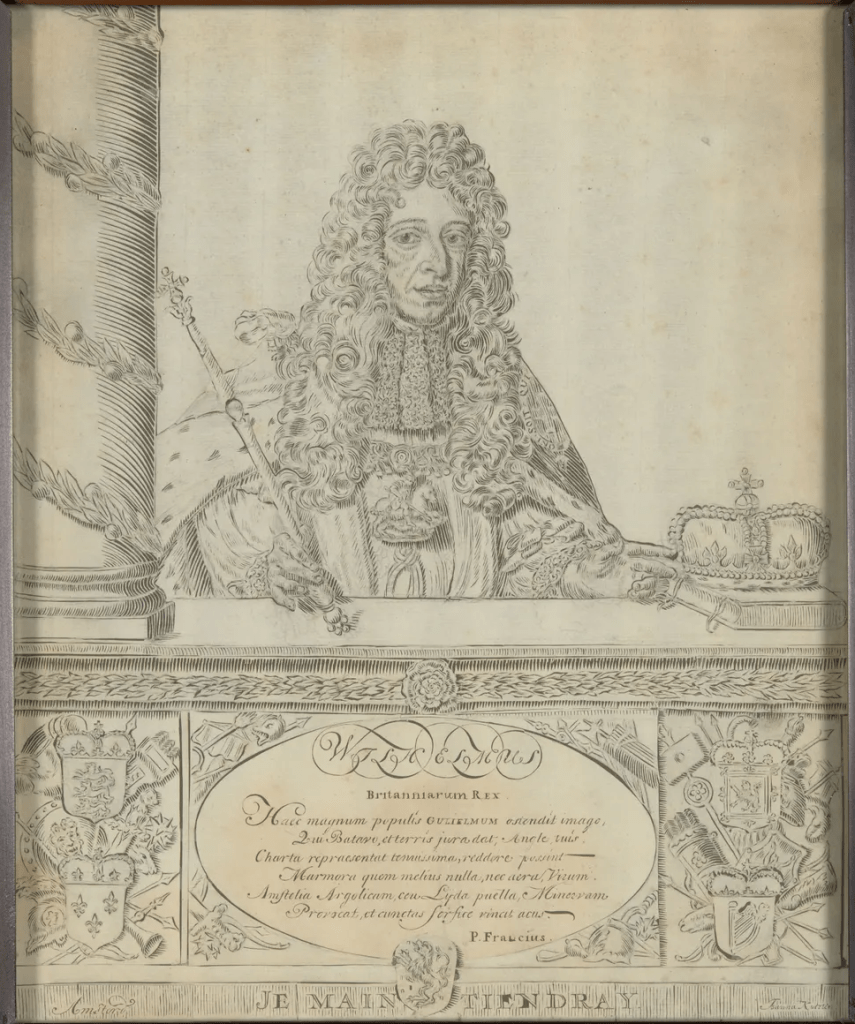
As we saw with Godewijck, some of these women were praised for embroidering with such skill that it looked like painting. Several handwriting styles used by Esther make the letters look as though they were stitched to the page. Similarly, the amazingly fine cut-paper work created by several of these artists, most especially Johanna Koerten (1650-1715), achieves the effect of pen-and-ink drawing produced by Esther and others of these Dutch artists.
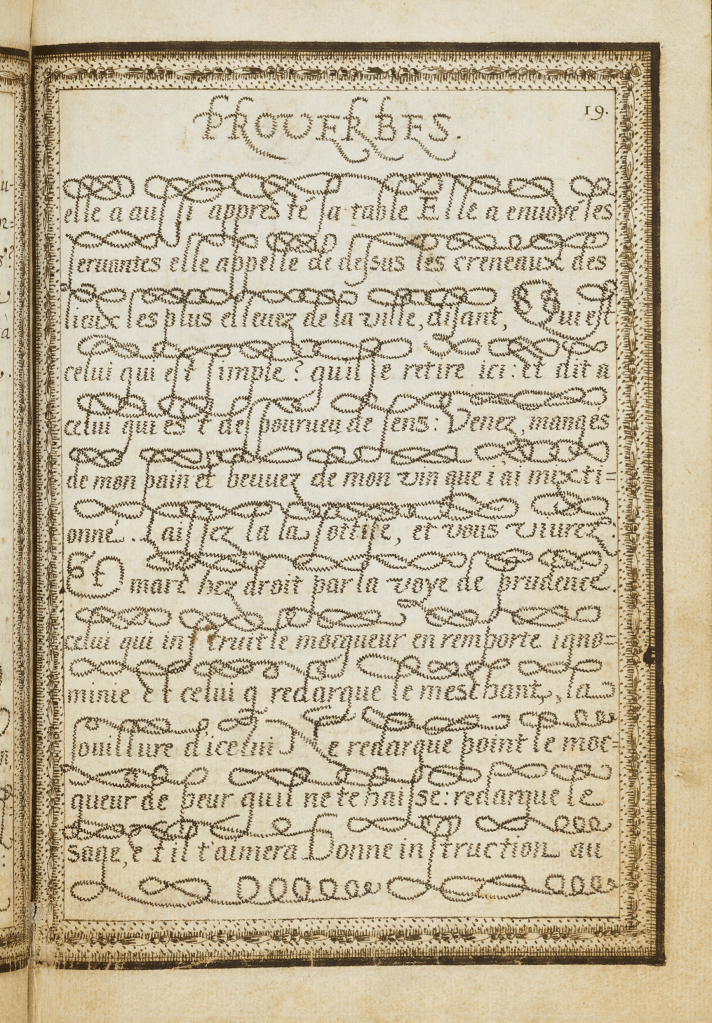
Esther Inglis, Proverbes de Salomon, 1599. Bodleian Library MS 990.
Johanna Koerten, Paper cutting of William III c.1700, Museum De Lakenhal, Leiden

As a Franco-Scot, Esther Inglis was herself of continental origin, part of that wave of talented immigrants who poured into England and Scotland during the Protestant Reformation. Artists, goldsmiths, jewelers, calligraphers, printers, engravers, weavers—men and women—they enriched British society in the sixteenth and seventeenth centuries with their artistic contributions. To find Esther’s female peers, we do well to look to France and the Netherlands.


  1. On Segar see Susan Frye, Pens and Needles: Women’s Textualities in Early Modern England (University of Pennsylvania Press, 2010). ↩︎
  2. Unforgettable: Women Artists from Antwerp to Amsterdam, 1600-1750, ed. Virginia Treanor and Frederica Van Dam (Ghent: Hannibal Books, 2025). ↩︎
  3. Treanor, p.27. ↩︎
  4. NMWA website: https://nmwa.org/art/collection/schurman-self-portrait/ ↩︎

Esther Inglis and “Little Beasts”

The National Gallery of Art in Washington DC has recently opened an exhibition titled “Little Beasts; Art, Wonder, and the Natural World.” I had my first slow walk-through yesterday and plan to return – maybe more than once!

It’s a small but marvelous exhibition focusing on sixteenth and seventeenth-century artists from the Netherlands who became passionate and detailed observers of the natural world, especially butterflies, moths, shells, and insects, but also larger animals, often strange ones from foreign shores. As the Dutch developed an extensive mercantile trade, they came into contact with new and exotic objects, often obtained for them by the efforts of the native peoples in the countries they visited, many in South Asia.

Joris Hoefnagel, Plate XXII from The Four Elements, c.1575-1590s. Watercolour and gold paint on parchment. NGA, Washington. Gift of Mrs. Lessing J. Rosenwald.

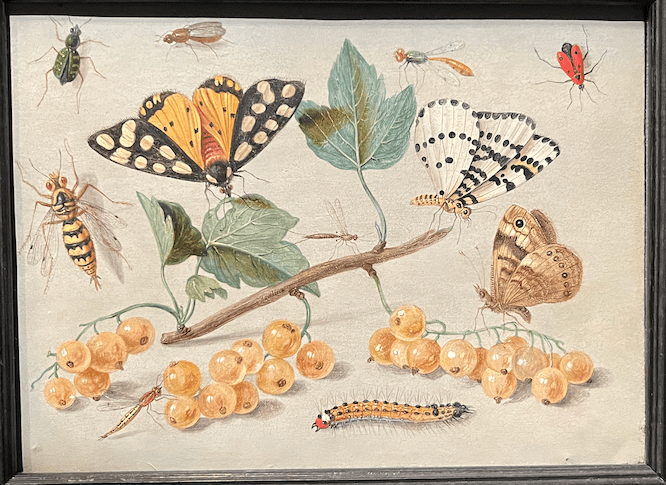
First focusing on Joris Hoefnagel (1542-1600), the exhibition details his working methods, and displays amazing examples from his watercolour series, “The Four Elements.” Then it moves on to his later counterpart, Jan van Kessel (1626-1679) who continued Hoefnagel’s studies in oil on copper. The NGA smartly partnered with the Smithsonian Museum of Natural HIstory to borrow specimens of actual animals, insects, and shells, shown alongside the artistic representations.

Jan van Kessel the Elder, Butterfly and Insects, c. 1655, oil on copper. NGA, Washington. Gift of John Dimick.

As soon as I walked in, I thought of Esther Inglis who used the same kinds of pigments as Hoefnagel – powdered red, green, and blue from natural sources mixed in shells – and similar brushes, samples of which are on display.

And Esther’s constant pairing of biblical and moral texts with her flowers, butterflies, birds, and frogs puts her in direct conversation with Hoefnagel and others at the time who “paired many drawings with Latin inscriptions of Bible verses, bits of poetry, mottos, or proverbs.” For them, the natural world was all a manifestation of God’s creation.

Esther Inglis, Argumenta Psalmorum, 1606. Houghton Library, MS Typ. 212
Esther Inglis, Argumenta Psalmorum, 1606. Houghton Library, MS Typ. 212 (cropped)

Flemish women artists were major contributors to floral works that often contained small insects, snails, or other creatures. An exquisite painting by Clara Peeters (c.1587-after 1636), features as the only work by a woman in the exhibition.

Clara Peeters, Still Life with Flowers surrounded by Insects and a Snail, c.1610. NGA, Washington. The Lee and Juliet Folger Fund.

She and Michaelina Wautier (c.1604-1689) were contemporaries of Esther Inglis, though Esther would not likely have seen their work. They were followed by Maria van Oosterwijck (1630-1693) and Rachel Ruysch (1664-1750) among others, plus the many women who painted with watercolour on paper, such as botanical artist Alida Withoos. For more about them, see the blog posts by Ariane van Suchtelen “Women and the Art of Flower Painting”, and by Catherine Powell, “Alida Withoos: Creator of beauty and of visual knowledge.”

We can assume that Esther Inglis would have enjoyed their company as she festooned her own works with flowers and critters from the same kinds of engravings copied by artists such as Hoefnagel and van Kessel. See my Folger blog: “Buds, Bugs, and Birds in the Manuscripts of Esther Inglis.”

“Little Beasts” is on through 2 November – go if you can, and check out their website for much more detail: https://www.nga.gov/exhibitions/little-beasts-art-wonder-and-natural-world

Showtime! More Celebrations for Esther @400!

Late October saw the unveiling of two new exhibitions on Esther Inglis – one virtual and permanent at Edinburgh University Library, and the other actual at the Folger Shakespeare Library in Washington, DC, on view from October 25 through early February.

Design by Ruth Nichols-Pike, Edinburgh

The splendid online exhibition, Rewriting the Script: the Works and Words of Esther Inglis, was developed by Anna Nadine Pike at EUL. It brings together an amazing collection of images of Esther’s manuscripts, along with videos talking about some of them, and audio readings of others. It invites the visitor to dig more deeply into examining her self-portraits, her use of embroidery, the various kinds of script she wrote, her use of printed materials, and much more. It’s a fabulous site for students to explore, so be sure to pass them the link!

Case Designs by Studio A, Alexandria, Virginia. Photo by Heather Wolfe

“Little Books, Big Gifts: the Artistry of Esther Inglis” on display in Washington, DC combines manuscripts from the Folger Library and from Harvard’s Houghton Library. These two institutions together hold the largest number of her manuscripts in the US: 6 at the Folger and 8 at Harvard. Twelve of these are now on display, in addition to several facsimile pages.

Courtesy Folger Shakespeare Library, photo by Tim Tiebout

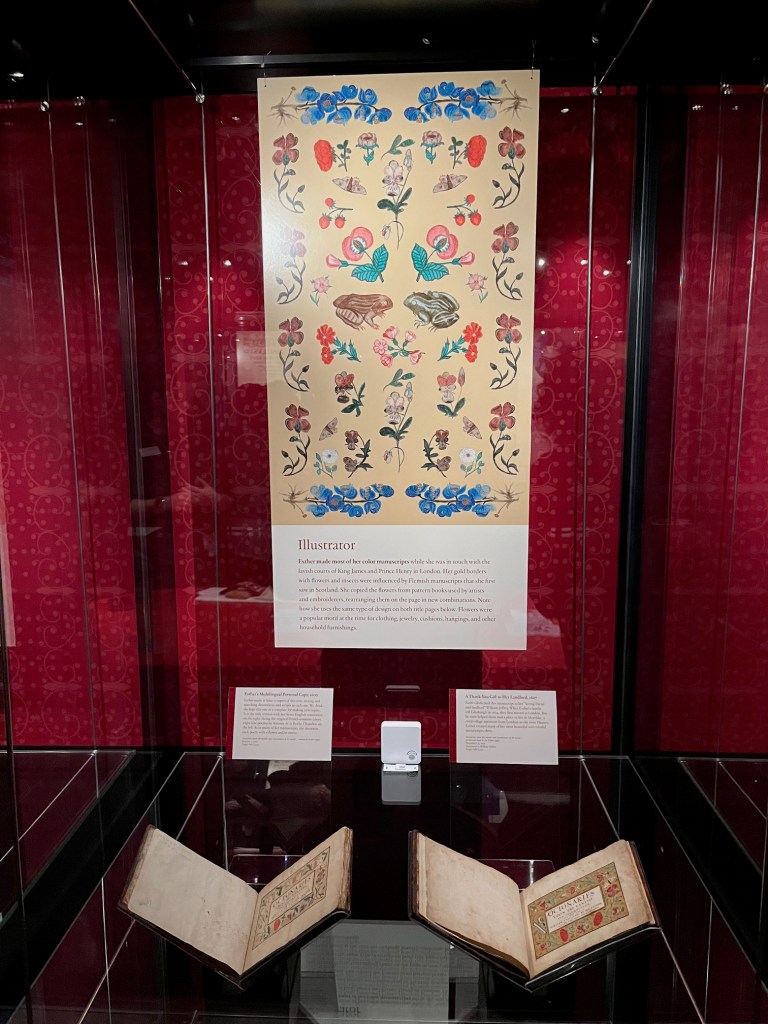
The exhibition creates a jewel-like setting for these beautiful books in cases titled: “Selfie Star”, “Gift Giver,” “Networker,” “Embroiderer,” “Illustrator,” and “Calligrapher.” It’s hard to realize how tiny some of these manuscripts are until you actually see them – no bigger than a matchbox. These seen below are two of the larger ones at 4.5 ” high and 6″ wide when closed.

“Illustrator” Case showing Folger MSS V.a.91 and V.a.92. Photo by G. Ziegler

The exhibition also features an exact reproduction of the embroidered binding Esther made for Folger MS V.a.93, a gift for Prince Maurice of Nassau in 1599. Professional embroiderers Christy Baty and Erin Moody painstakingly re-created the velvet and seed-pearl binding, while the Folger’s Conservation Lab made a tiny reproduction of the manuscript to size to fit into the binding. This manuscript is just under 4″ high and about 2.5″ wide when closed.

Reproduction of V.a.93 – text block on left. Photo by G. Ziegler

If you can’t make it in person, then enjoy the video about Esther’s “Selfies” here: https://www.youtube.com/watch?v=EK7QYU3YkaU and see a gallery of Esther’s manuscripts on the main exhibition page.  Want more? go to the page on this website for Locations of digitized manuscripts: https://estheringlis.com/ms-locations/ and enjoy!

Esther’s “selfies” used in Folger exhibition video. Photo from Folger website.