
Late October saw the unveiling of two new exhibitions on Esther Inglis – one virtual and permanent at Edinburgh University Library, and the other actual at the Folger Shakespeare Library in Washington, DC, on view from October 25 through early February.

Design by Ruth Nichols-Pike, Edinburgh
The splendid online exhibition, Rewriting the Script: the Works and Words of Esther Inglis, was developed by Anna Nadine Pike at EUL. It brings together an amazing collection of images of Esther’s manuscripts, along with videos talking about some of them, and audio readings of others. It invites the visitor to dig more deeply into examining her self-portraits, her use of embroidery, the various kinds of script she wrote, her use of printed materials, and much more. It’s a fabulous site for students to explore, so be sure to pass them the link!

Case Designs by Studio A, Alexandria, Virginia. Photo by Heather Wolfe
“Little Books, Big Gifts: the Artistry of Esther Inglis” on display in Washington, DC combines manuscripts from the Folger Library and from Harvard’s Houghton Library. These two institutions together hold the largest number of her manuscripts in the US: 6 at the Folger and 8 at Harvard. Twelve of these are now on display, in addition to several facsimile pages.

Courtesy Folger Shakespeare Library, photo by Tim Tiebout
The exhibition creates a jewel-like setting for these beautiful books in cases titled: “Selfie Star”, “Gift Giver,” “Networker,” “Embroiderer,” “Illustrator,” and “Calligrapher.” It’s hard to realize how tiny some of these manuscripts are until you actually see them – no bigger than a matchbox. These seen below are two of the larger ones at 4.5 ” high and 6″ wide when closed.
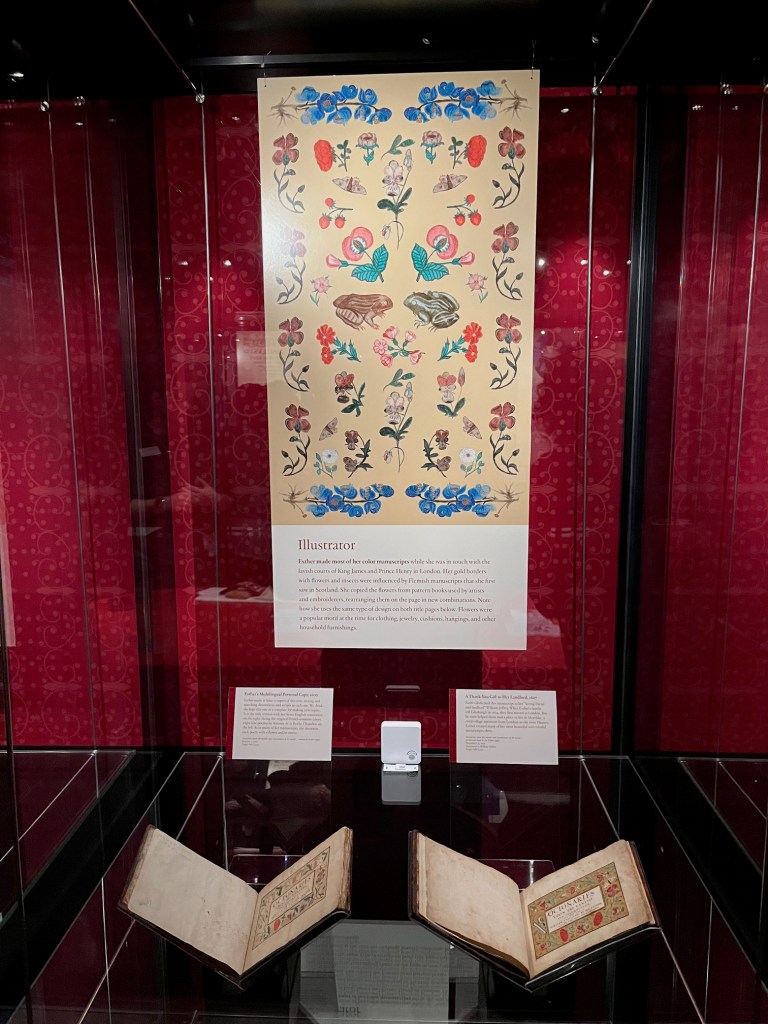
“Illustrator” Case showing Folger MSS V.a.91 and V.a.92. Photo by G. Ziegler
The exhibition also features an exact reproduction of the embroidered binding Esther made for Folger MS V.a.93, a gift for Prince Maurice of Nassau in 1599. Professional embroiderers Christy Baty and Erin Moody painstakingly re-created the velvet and seed-pearl binding, while the Folger’s Conservation Lab made a tiny reproduction of the manuscript to size to fit into the binding. This manuscript is just under 4″ high and about 2.5″ wide when closed.

Reproduction of V.a.93 – text block on left. Photo by G. Ziegler
If you can’t make it in person, then enjoy the video about Esther’s “Selfies” here: https://www.youtube.com/watch?v=EK7QYU3YkaU and see a gallery of Esther’s manuscripts on the main exhibition page. Want more? go to the page on this website for Locations of digitized manuscripts: https://estheringlis.com/ms-locations/ and enjoy!
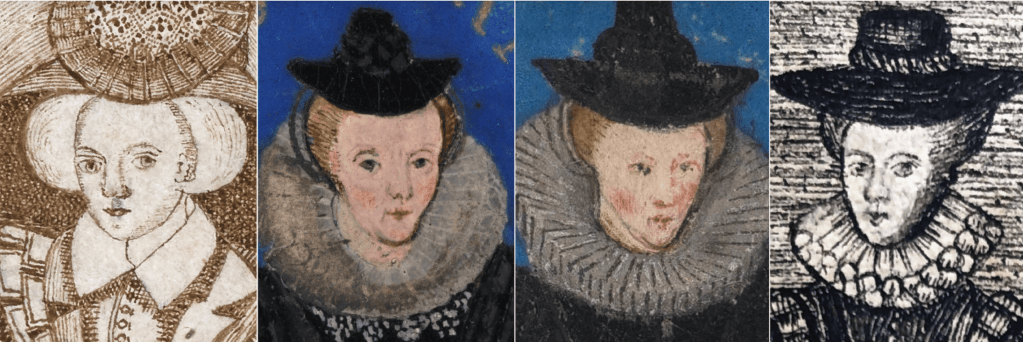
Esther’s “selfies” used in Folger exhibition video. Photo from Folger website.
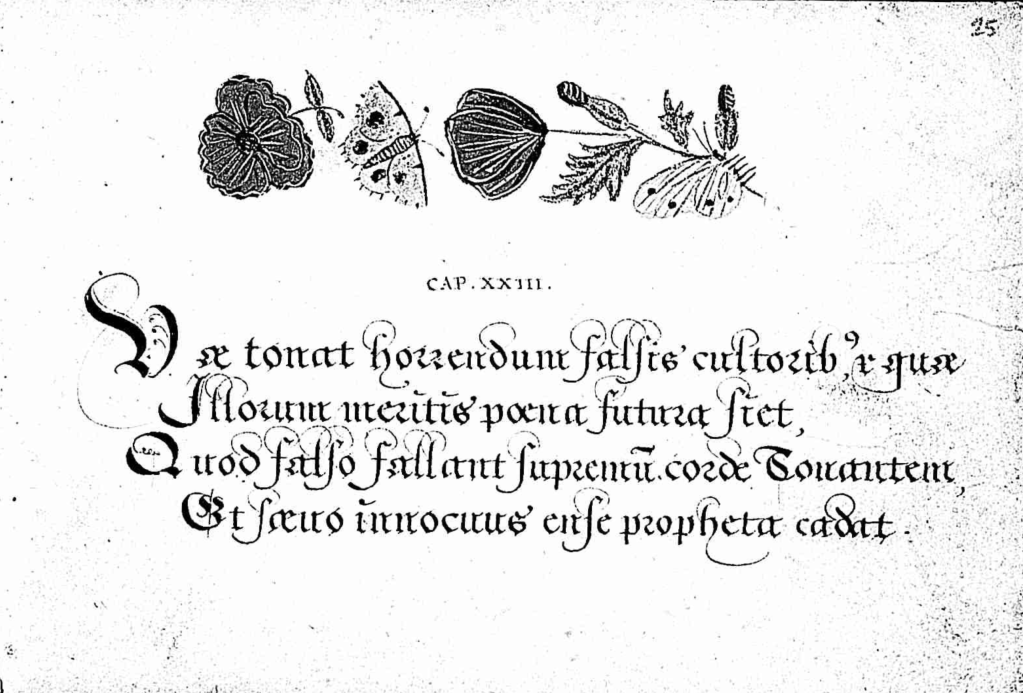

 Esther Inglis (c1570-1624): Calligrapher, Artist, Embroiderer, Writer