
On 26 January 1607, Esther Inglis presented a copy of Gwalther’s Latin verse summary of the Gospel of Matthew “To the Right Honorable and Most Noble Lord, William Earle of Morton, Lord of Dalkeyth, &C.” At the age of twenty-four, William Douglas had succeeded to his grandfather’s title and become 7th Earl of Morton in November 1606. Two years earlier he had married Lady Anne Keith, daughter of George Keith, fourth earl Marischal (ODNB).
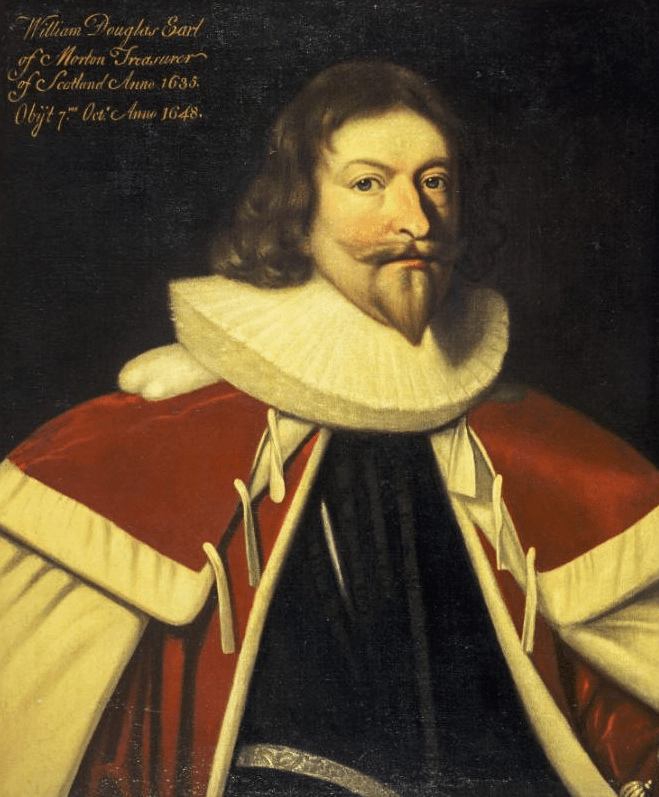
William Douglas, 7th Earl of Morton, from a painting at Dalmahoy
David Murray, Esther’s “ear” at court, must have told her that Morton was arriving in London where she was residing in 1606. Esther writes, “sen I hard of yr cumming to this cantrie, I haue bene exercised in perfyting this litle book dedicated to yr Lo:” She had never met him, but he was obviously an up-and-coming young man from a very distinguished family (Mary Queen of Scots had been kept at his grandfather’s castle Lochleven). Esther writes: “My Lord, that one vnknown to your Lo: hes emboldned hir selfe to present you with a few grapes of hir collection, I hope your Lo: shal not altogether mislyk therof.”
Esther also hopes that she won’t “be estemed impudent in transending the limites of scham fastnes (wherwith our sexe is commonlie adorned) in offring this small work of my pen and pensill . . . Beseeching you accept of it and the rather becaus it is a womans work.” This bowing and scraping of course is merely an expected stance, used by both sexes at the time; Esther knows full well the beauty and value of her work.
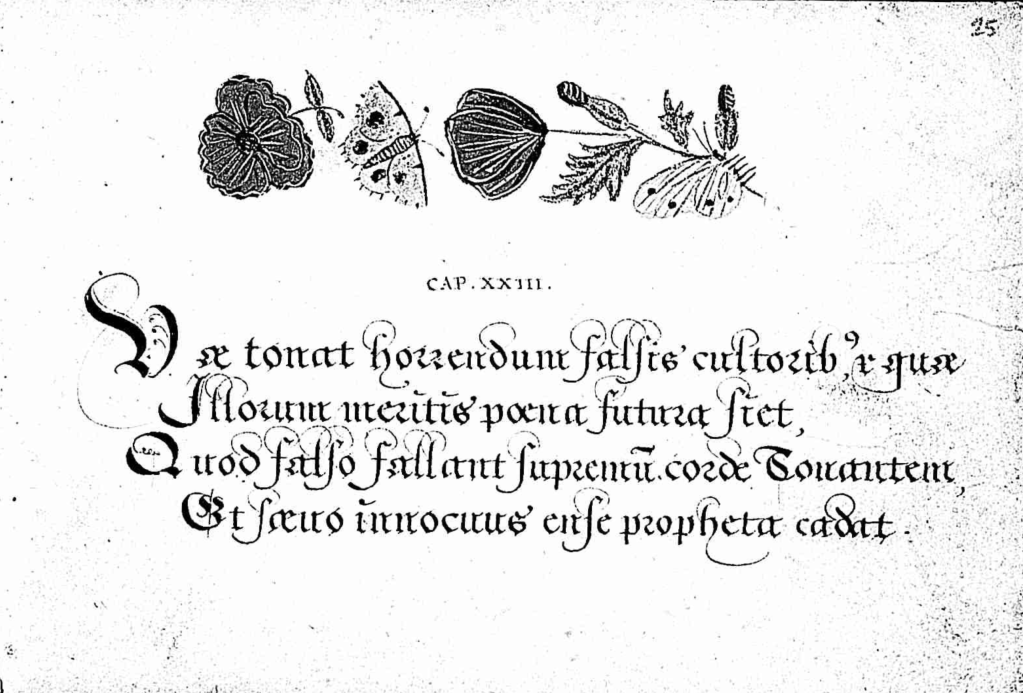
Esther Inglis, Argumenta singulorum capitum Evangelii Matthaei Apostoli, 26 January 1607. NLS MS Acc. 11821. Image from Perdita
The 7th Earl went on to become a member of the Scottish Privy Council, and in 1630, Lord High Treasurer of Scotland. We don’t know what he thought of the manuscript; perhaps he passed it on to his wife, Anne. It is certainly beautiful, decorated with Esther’s signature style of a flower-strewn, gold title-page frame, and fine drawings of flowers on each page of text. In the early eighteenth century, the manuscript passed into the hands of a young woman, Grizel Nimmo (1688-1730). She noted her ownership several times on the verso of folio 30: “This Book at present doth belong unto me Grisall Nimmo” and “I Grizell Nimmo aught ys Book 1712/ Grishilda Nimmo.” Much information on Grizzell’s family and subsequent owners is filed with the manuscript in the National Library of Scotland.

Esther Inglis, Argumenta singulorum capitum Evangelii Matthaei Apostoli, 26 January 1607. NLS MS Acc. 11821, fol. 30v. Image from Perdita
 Esther Inglis (c1570-1624): Calligrapher, Artist, Embroiderer, Writer