Clerical Gifts in the Month of June

In June 1617, Esther presented small manuscripts to two important clergymen, Joseph Hall, formerly chaplain to Prince Henry, and now Dean of Worcester, and Walter Balcanquhall, a chaplain to James I. By this time, she was back in Edinburgh, living in Leith. She and Bartilmo had left Essex in 1614 after two of their sons died and were buried at St Andrews church there, where Bartilmo had a living. The family stayed in London for a brief time, before returning to Scotland.

These two manuscripts are very plain, and are part of a group that Esther made during this transition period around 1615-16. She may have chosen two clergymen in hopes of encouraging some support for Bartilmo’s career after their move. Importantly, both men were in the entourage of James VI and I when he came back to Scotland for the first and only time during the summer of 1617.

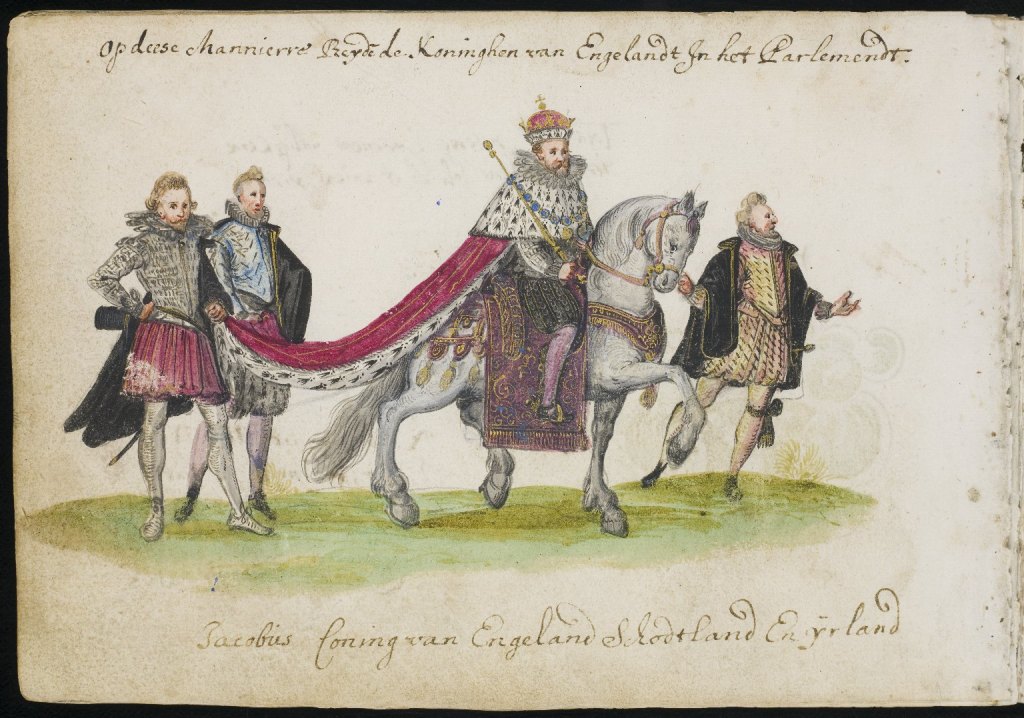
King James traveling to Parliament from the album of Michel Van Meer. University of Edinburgh Library, La.III.283, fol. i59v.

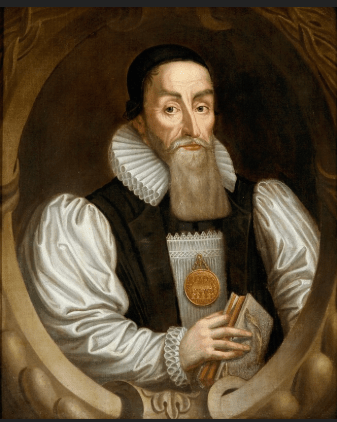
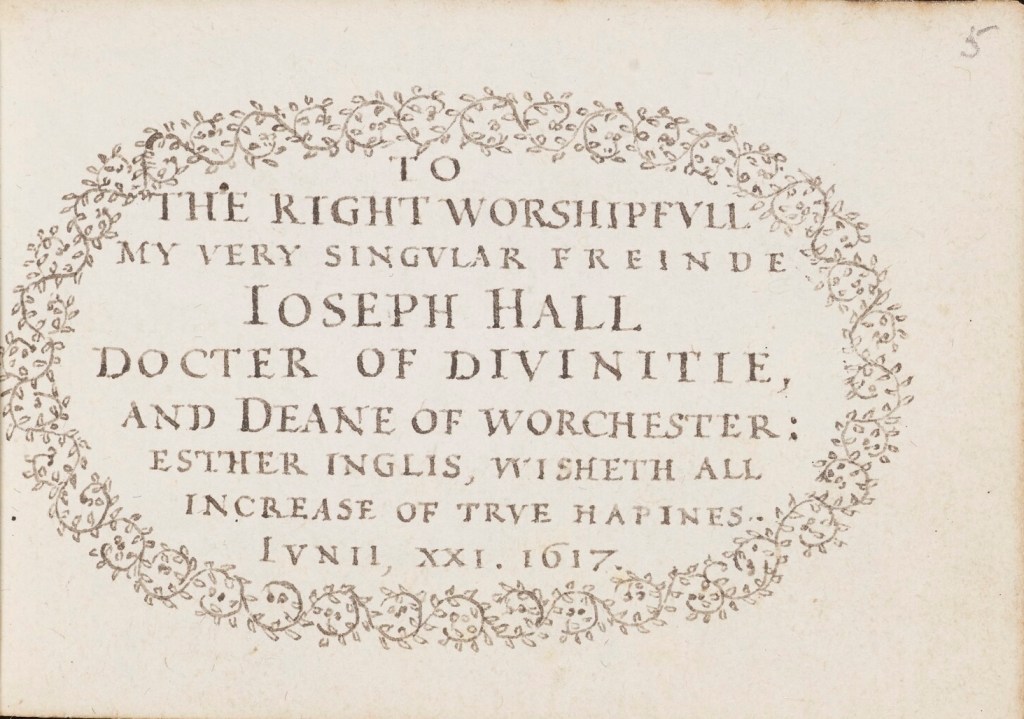
The first manuscript is written in black ink with little decoration. It is a copy of one of Esther’s favorite texts, the moral poetic Quatrains by the Sieur de Pybrac. In the simple dedication written within a leafy frame she calls Hall “My very singular Freinde,” and dates the work to June 21, 1617. Joseph Hall (1574-1656) was educated at Emmanuel Hall, Cambridge. As a young man, he wrote satiric poetry but then launched himself on a career in the clergy. One of his first positions in Suffolk brought him in touch with the Drury family, and also the poet John Donne, with whom he became friends.

Joseph Hall after John Payne, possibly painted by Mary Beale (1633-1699). Emmanuel College, Cambridge.

By 1607 Hall had moved on to a living in Essex and had become a chaplain to Prince Henry. Esther’s friendship with Hall may stem from his Essex days and his association with the prince’s court. Hall was a popular preacher in London, and became Dean of Worcester not long before accompanying King James to Scotland.

Esther Inglis, Dedication to Bodleian Library MS. Bodl. 987. Detail of Photo: © Bodleian Libraries, University of Oxford.

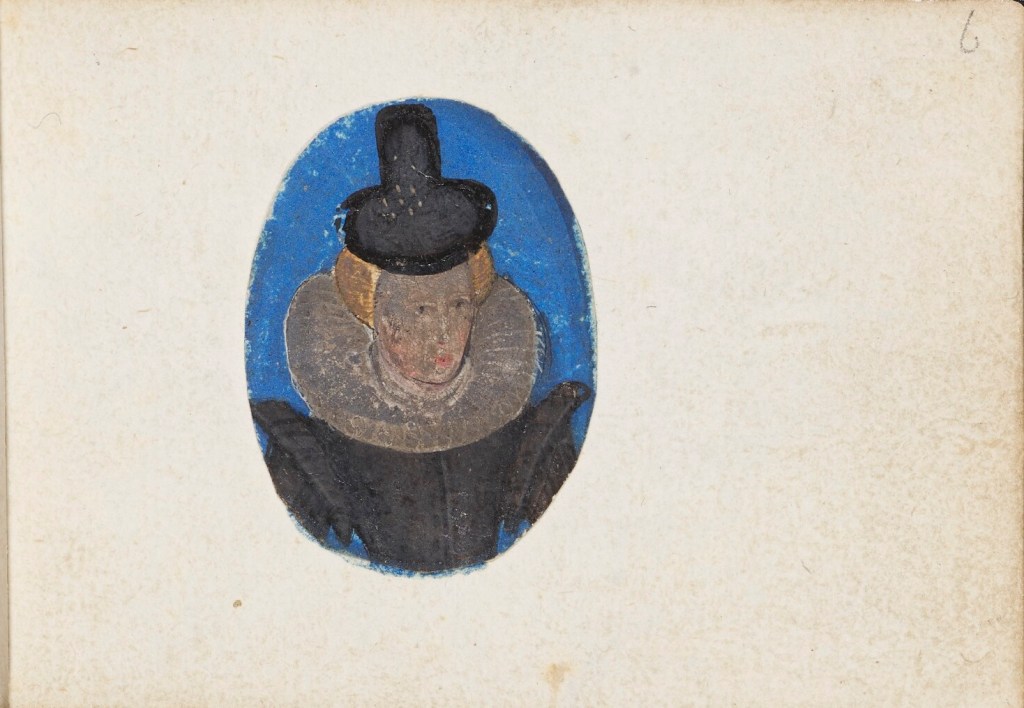
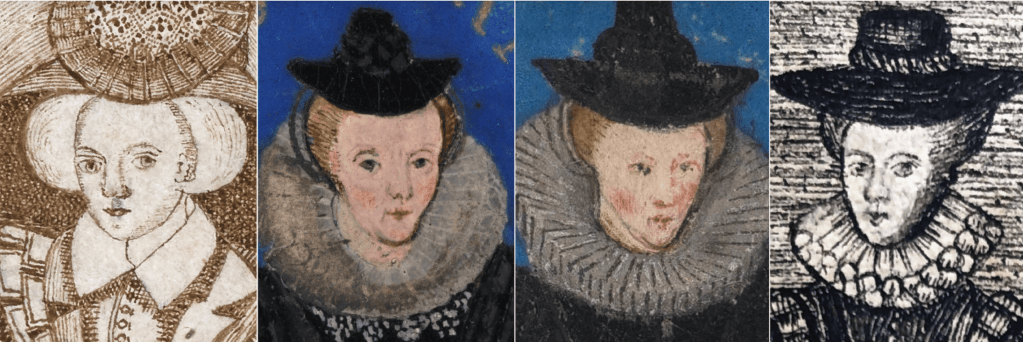
Although there is no interior decoration, and the script throughout is Roman, Esther does include a self-portrait miniature, which she pasted in. The color has somewhat deteriorated, but it shows her in a tall black hat with white ruff.

Esther Inglis, Self-portrait in Bodleian Library MS. Bodl. 987. Detail of Photo: © Bodleian Libraries, University of Oxford.

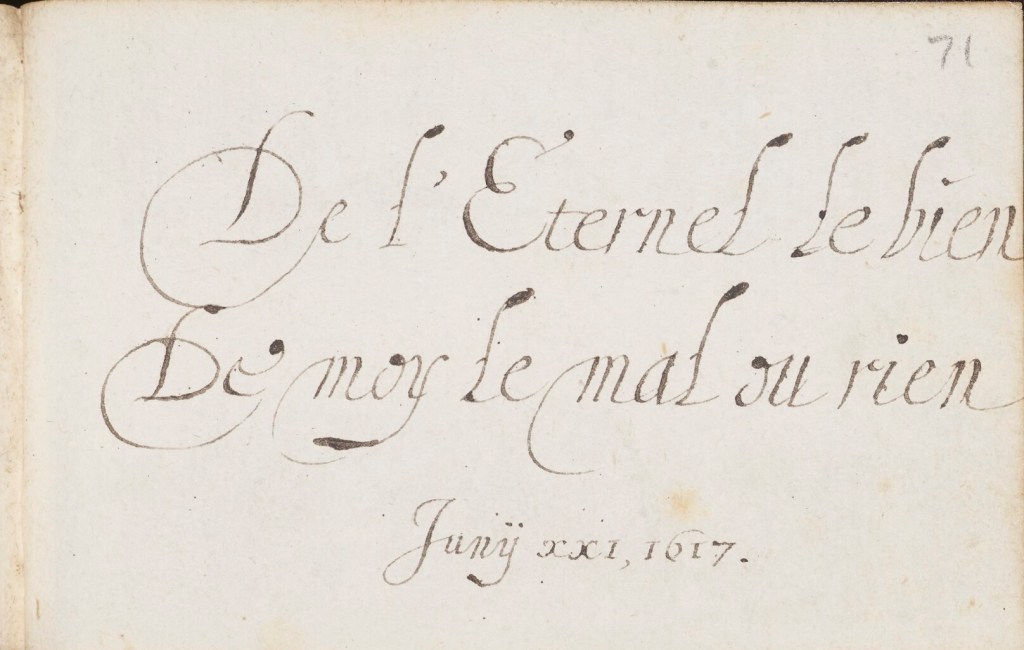
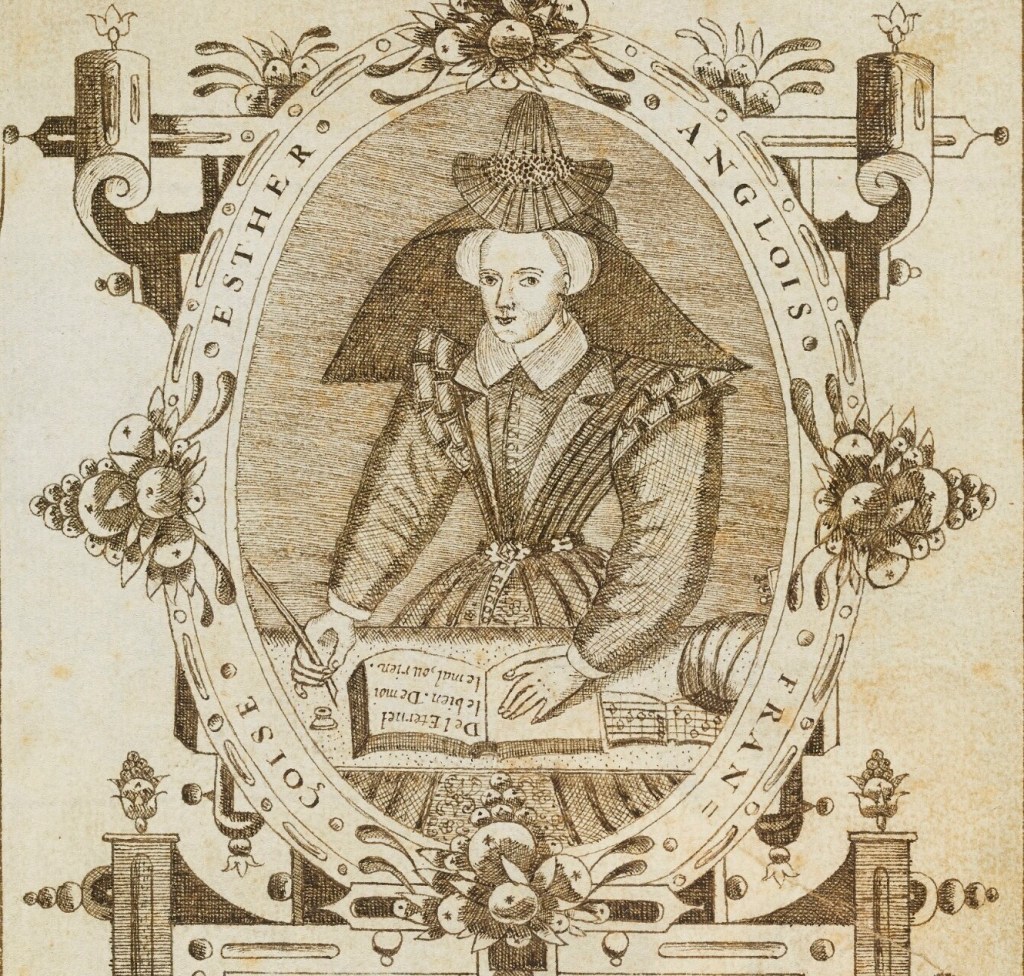
In earlier manuscripts, Esther tended to write her motto on a little book on her desk within her self-portrait, but here she puts it at the end of Hall’s manuscript. The two lines come originally from a poem by the exiled Huguenot minister, Marin le Saulx: “All good gifts come from God; of myself I am nothing.” Near the beginning, she placed the motto that she used in later manuscripts, “Durum patientia frango” (“With patience I overcome difficulty”).

Esther Inglis, motto at end of Bodleian Library MS. Bodl. 987. Detail of Photo: © Bodleian Libraries, University of Oxford.

We don’t have a portrait of Walter Balcanquhall (c.1586-1645), the other minister to whom Esther gave a similar manuscript that same summer of 1617. He was a Scot, educated at the universities of Edinburgh and Cambridge. Esther likely knew his father, Walter senior, who became a prominent minister at St. Giles in Edinburgh. Walter junior pursued a successful career in England, becoming Master of the Savoy, chaplain to King James, and eventually Dean of Rochester, but whereas his father was a staunch presbyterian, the son became an episcopalian, and in later years, sided with Charles I against the Scottish covenanters.

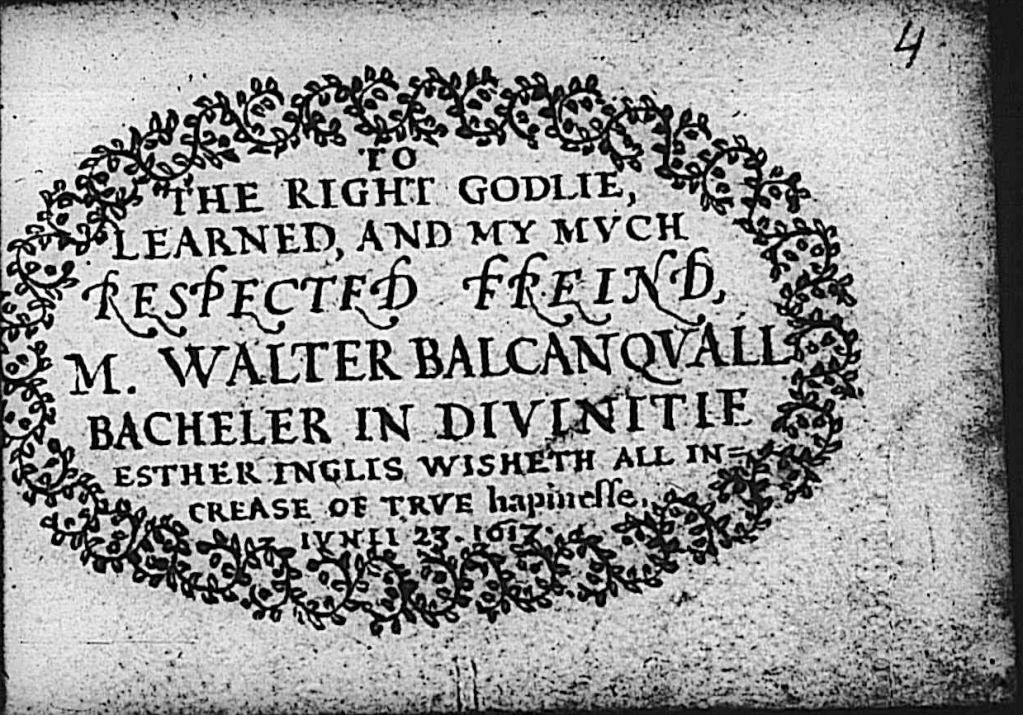
Esther’s gift to him was also a copy of the Quatrains, just as plainly produced, but without her self-portrait. This is British Library Additional MS 22606. She includes the two mottoes as above. Unfortunately, the only photos currently available are the old black-and-white ones from Perdita. I’ve heard that the BL has digitized all the Esther Inglis manuscripts but they are not yet online.

Esther Inglis, dedication in British Library Add. MS 22606. Photo from Perdita online database.

Showtime! More Celebrations for Esther @400!

Late October saw the unveiling of two new exhibitions on Esther Inglis – one virtual and permanent at Edinburgh University Library, and the other actual at the Folger Shakespeare Library in Washington, DC, on view from October 25 through early February.

Design by Ruth Nichols-Pike, Edinburgh

The splendid online exhibition, Rewriting the Script: the Works and Words of Esther Inglis, was developed by Anna Nadine Pike at EUL. It brings together an amazing collection of images of Esther’s manuscripts, along with videos talking about some of them, and audio readings of others. It invites the visitor to dig more deeply into examining her self-portraits, her use of embroidery, the various kinds of script she wrote, her use of printed materials, and much more. It’s a fabulous site for students to explore, so be sure to pass them the link!

Case Designs by Studio A, Alexandria, Virginia. Photo by Heather Wolfe

“Little Books, Big Gifts: the Artistry of Esther Inglis” on display in Washington, DC combines manuscripts from the Folger Library and from Harvard’s Houghton Library. These two institutions together hold the largest number of her manuscripts in the US: 6 at the Folger and 8 at Harvard. Twelve of these are now on display, in addition to several facsimile pages.

Courtesy Folger Shakespeare Library, photo by Tim Tiebout

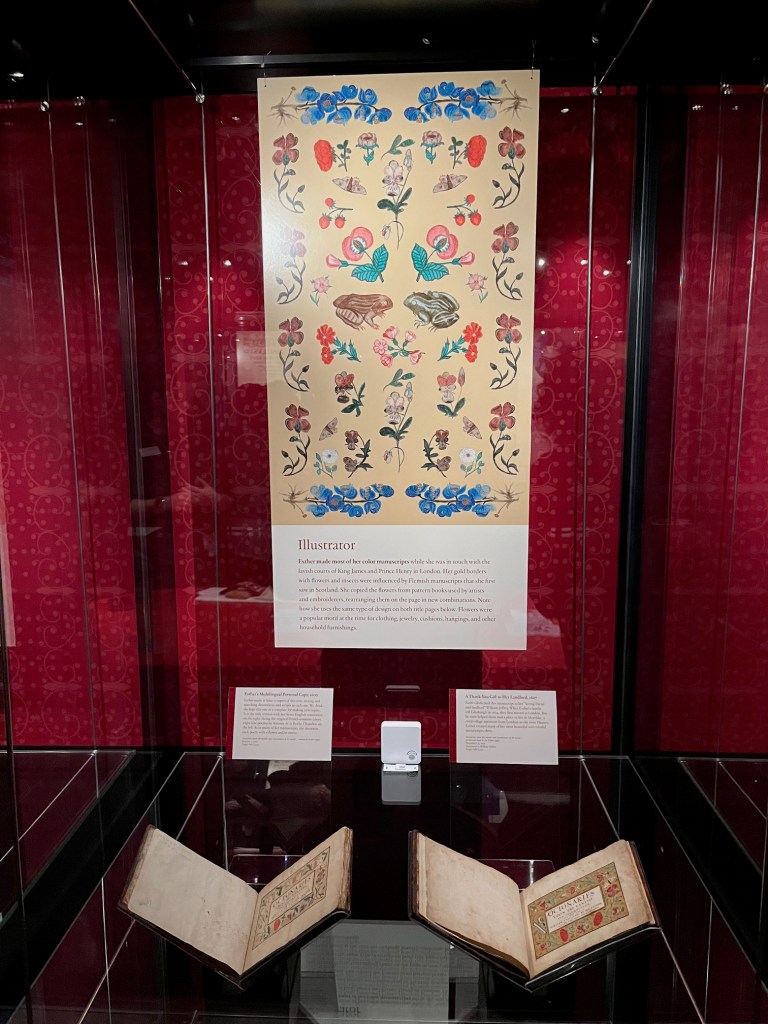
The exhibition creates a jewel-like setting for these beautiful books in cases titled: “Selfie Star”, “Gift Giver,” “Networker,” “Embroiderer,” “Illustrator,” and “Calligrapher.” It’s hard to realize how tiny some of these manuscripts are until you actually see them – no bigger than a matchbox. These seen below are two of the larger ones at 4.5 ” high and 6″ wide when closed.

“Illustrator” Case showing Folger MSS V.a.91 and V.a.92. Photo by G. Ziegler

The exhibition also features an exact reproduction of the embroidered binding Esther made for Folger MS V.a.93, a gift for Prince Maurice of Nassau in 1599. Professional embroiderers Christy Baty and Erin Moody painstakingly re-created the velvet and seed-pearl binding, while the Folger’s Conservation Lab made a tiny reproduction of the manuscript to size to fit into the binding. This manuscript is just under 4″ high and about 2.5″ wide when closed.

Reproduction of V.a.93 – text block on left. Photo by G. Ziegler

If you can’t make it in person, then enjoy the video about Esther’s “Selfies” here: https://www.youtube.com/watch?v=EK7QYU3YkaU and see a gallery of Esther’s manuscripts on the main exhibition page.  Want more? go to the page on this website for Locations of digitized manuscripts: https://estheringlis.com/ms-locations/ and enjoy!

Esther’s “selfies” used in Folger exhibition video. Photo from Folger website.