
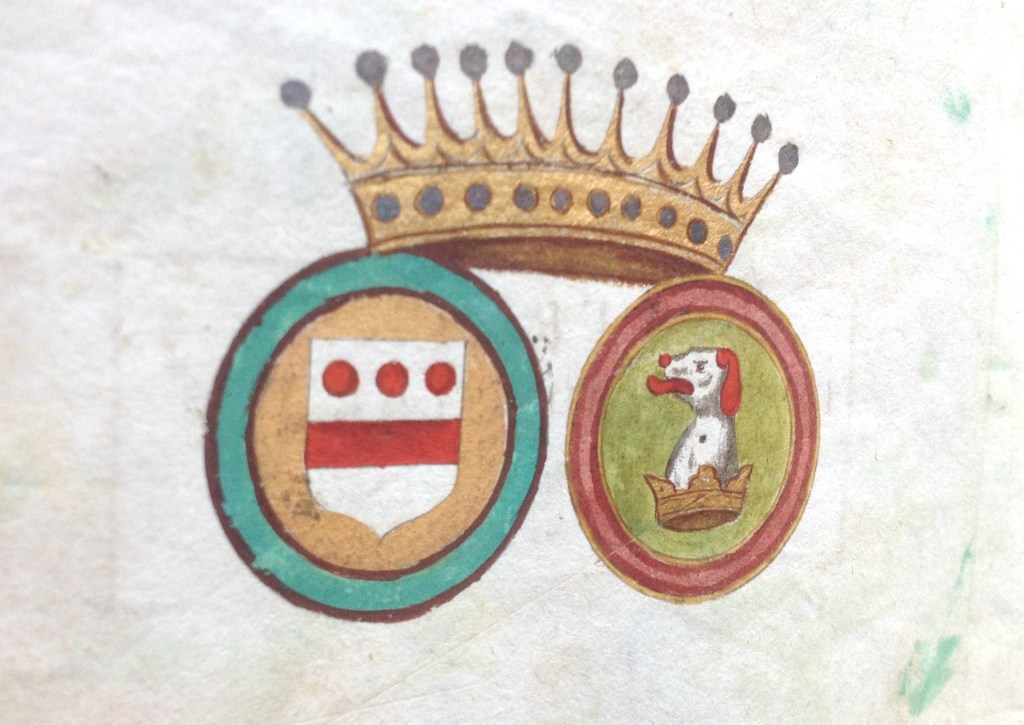
Arms of Robert, 3rd earl of Essex, Royal Library Copenhagen, MS Thott 323 – see more on this item below.
On 3 September 1574, the Edinburgh town council granted to Nicolas Langlois and Marie Presot, Esther’s parents, a ‘commodious house’, rent-free, for themselves and the new French school Nicolas was to run. He was to be paid an annual salary of £20 plus 25 shillings for every child enrolled. The couple were newly arrived in Edinburgh as Huguenot refugees, having spent a few years in London, and the town was expecting them. Their new ‘commodious house’ was “at the New Well,” the corner of Horse Wynd [now Guthrie St] and Cowgate. Esther was about four years old at the time.

Detail from William Edgar, Plan of the city and castle of Edinburgh, 1742 NLS The well is the little square at the top off Cowgate where it intersects with Horse Wynd.
For other September dates, we skip ahead to Esther’s years in and around London, where she and her husband Bartilmo Kello went in 1604, following King James VI who succeeded to the English crown in 1603. One of Esther’s early employments in London was making a copy of their friend David Hume of Godescroft’s De Unionis, part 2, at Hume’s request. The first part of Hume’s argument for a British union had just been published in 1605, and the issue was being debated in Parliament. Esther finished her good copy of Part 2 on 20 September 1605, when the letter “To the Reader” is dedicated. The second part was so politically “hot”, however, that it was not printed until modern times. The front is decorated with just one red rose and a bud.

David Hume of Godescroft, Vincula Unionis, written out by Esther Inglis, 1605. EUL La.III.249
The following year, in September 1606, Esther presented a copy of one of her favourite sets of moral verses, Pybrac’s Quatrains, to fifteen-year-old Robert Devereux, son of the disgraced Earl of Essex for whom Bartilmo had worked. Robert was rehabilitated by King James and educated with Prince Henry. He had just been forced into marriage with another teenager, Frances Howard. Since neither was ready for wedded life, it was suggested that Robert take a Grand Tour. Esther writes in her dedication: “Monseigneur, having heard of the departure of your Lordship out of this Realm, towards the country of France, and remembering how graciously Monseigneur your very illustrious father of eternal memory received the fruits of my pen, I have prepared to devise this little work which I present in all reverence to your Lordship, praying that the Eternal will watch over you, lead you, and make you return with joy.”

Esther’s dedication to “Robert Conte D’Essex”, in Royal Library Copenhagen, MS Thott 323
Finally on 15 September 1612, Esther gave Prince Henry a copy of the Psalmes of David in a lovely embroidered binding of flowers in a vase. In her lengthy dedication, she impresses upon the prince once again the importance of staying on the right path in life by reading the scriptures, and especially the Psalms. She describes her little book thus: “This heavenly ladder, upo[n] the which I have bestowed a simpel ornement the bettir to decoir [decorate] it, contayning the Spiritualle songs of the sweit singer of Israell is convenient to be takin in your Princlye hand and from ye hand to be layd up in your heart.” This is the last gift that Esther would give the prince, as he died on 6 November 1612.

Esther’s self-portrait in Psalmes dedicated “To the Most Excellent Hopfull and Peirlesse P. Henrie Prince of great Britaine.” Folger V.a.665

