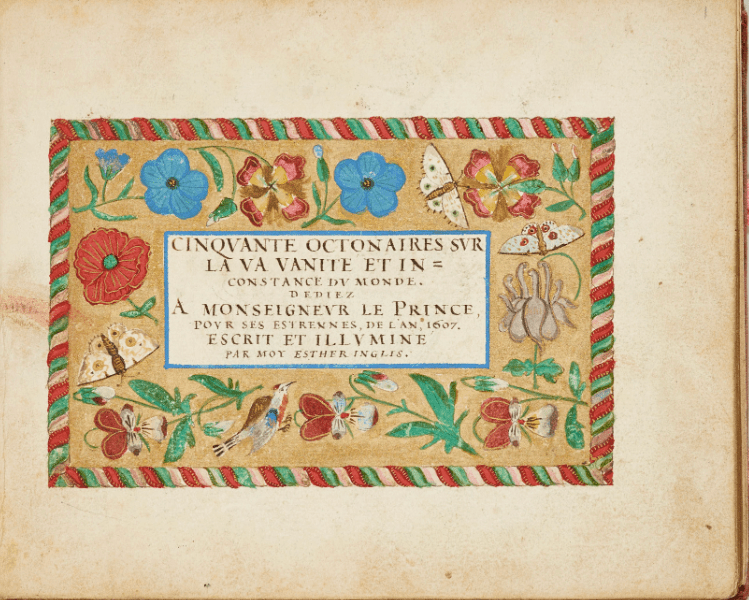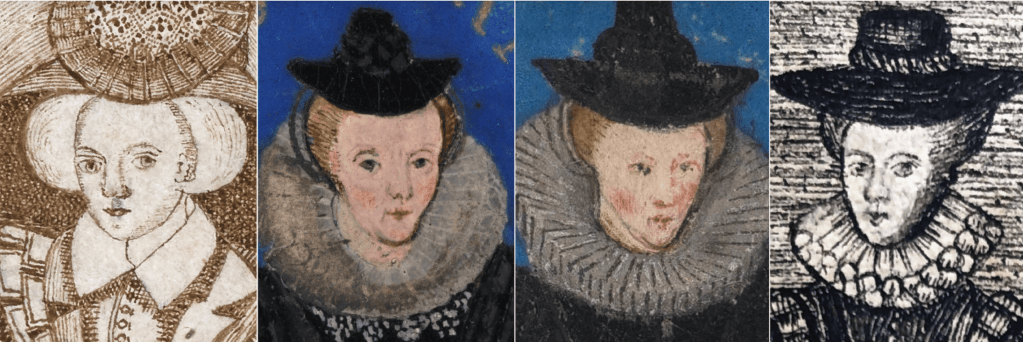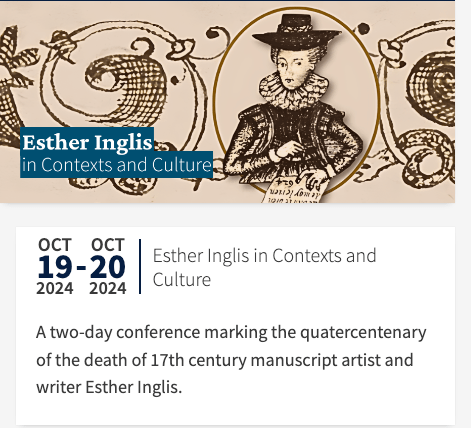
Women of Many Talents

Calligrapher, limner, embroiderer, writer – those are all arts in which Esther Inglis engaged. She seems to have been unique in Britain at the time, so who were her cohorts?
There must have been other contemporary British women who were multi-talented, but it’s not easy to find them. Certainly upper-class women, including queens Elizabeth and Mary of Scots, learned to embroider and often had handwriting lessons, but they didn’t use their talents professionally.

Mary Queen of Scots monogram. Museum no. T.29-1955. © Victoria and Albert Museum, London

Jane Segar, Enamel on velvet front binding from British Library, Add. MS 10037

Then there was Jane Segar, from an artistic family, who wrote out her own poems on the Sibylls in a beautiful hand, and bound them in a jewel-like enamel binding for Queen Elizabeth, but this work seems to be unique.1

To find really multi-talented professional women artists working on a scale similar to Esther’s we need to turn to the continent, and especially, the Netherlands. Many of them will be found in an exhibition on now (until Jan. 11, 2026) at the National Museum of Women in the Arts: “Women Artists from Antwerp to Amsterdam, 1600-1750.”2

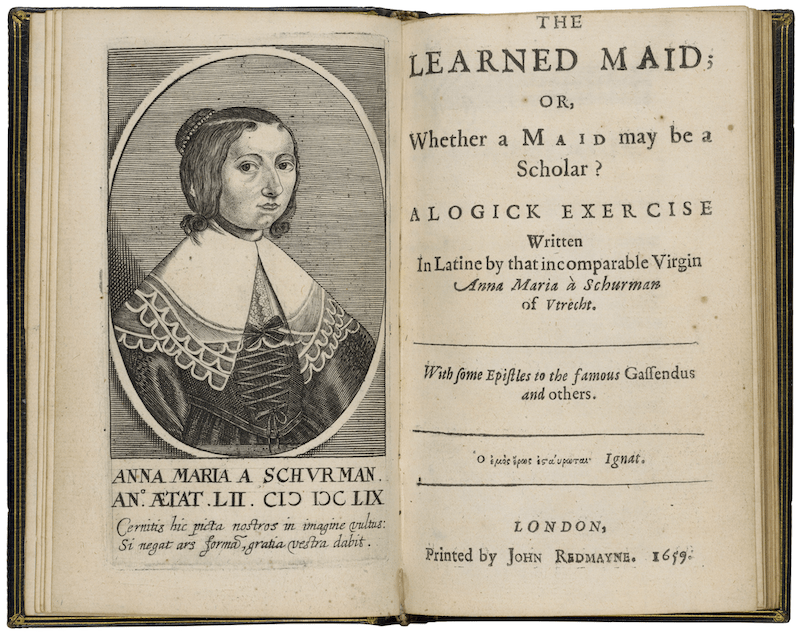
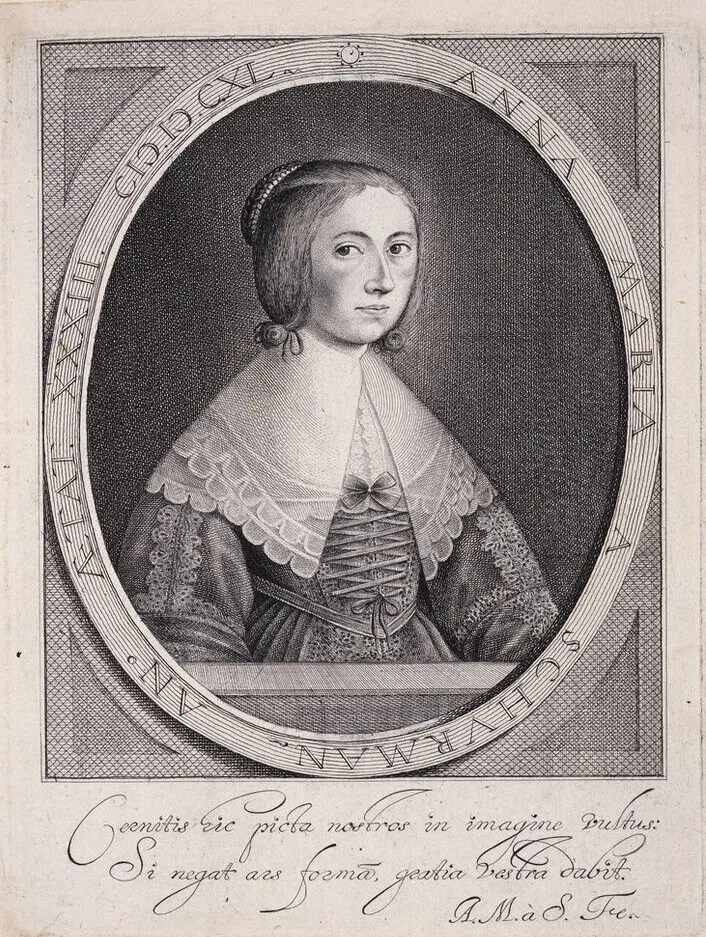
Most of these women were from professional families; some like Esther had a father who was an educator. Often other members of their family were involved in the arts, like Esther’s calligrapher mother Marie Presot, and many were multi-talented. One of the best-known is Anna Maria van Schurman (1607-1678), a scholar, writer and calligrapher who also made drawings, and engraved on copper and glass.

English translation of Schurman’s work, with engraving of her self portrait. First published in Latin in 1641, then in London in 1659. Folger Shakespeare Library.

Then there is Margaretha van Godewijck, known only by reputation, since her works are lost. Her talents were described by Arnold Houbraken in his Great Theatre of Dutch Painters and Paintresses (1718): “She was able to stitch landscapes, farms, houses, flowers and all kinds of ships, as well as paint everyting in oil and water paints. . . She was also able laudably to depict all sorts of objects in pen and pencil, [and] could further write inventively on glass . . . .”[3]

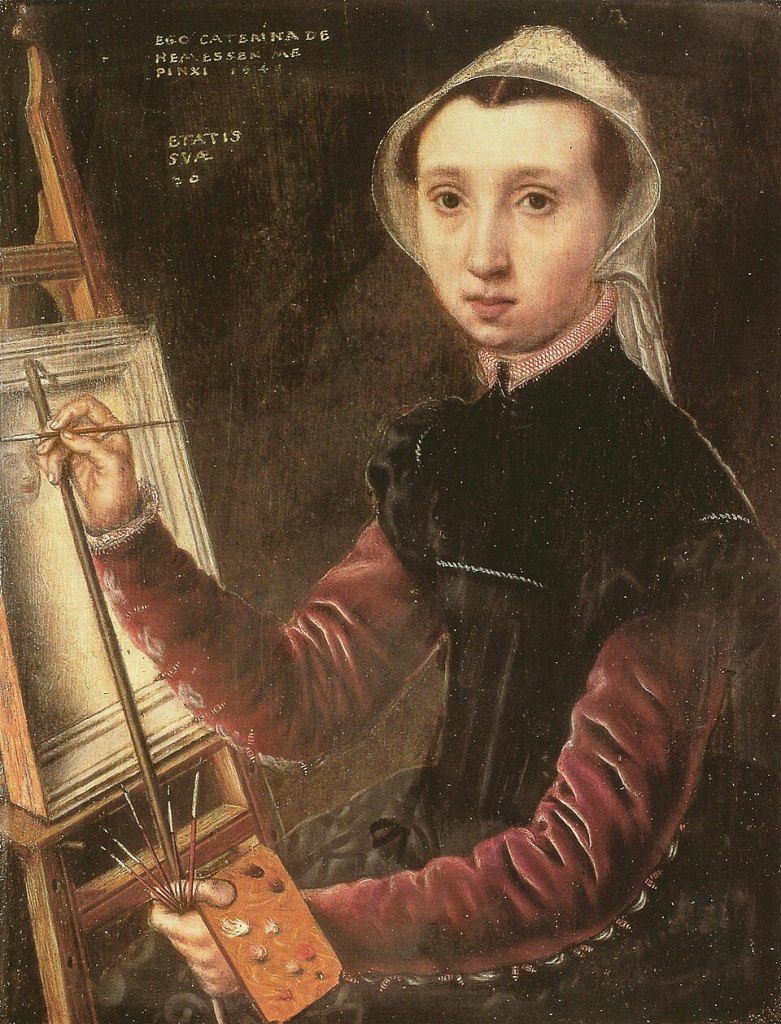
More than 40 versatile women artists—painters, sculptors, embroiderers, lacemakers, printmakers, papercutters—are featured in the exhibition and catalogue, along with self portraits. Esther Inglis was the first woman in Britain to include self portraits with her works, but she had a forerunner in Catharina van Hemessen (1548), the first European artist of either sex to create a self portrait.3 After Hemessen, many other Dutch women artists, including van Schurman and Judith Leyster followed suit.

Catherina van Hemessen, Self portrait, 1548. Öffentliche Kunstsammlung, Kunstmuseum, Basel. Dépôt de l’Institut Professeurs Bachofen et J.J. Burckhardt, 1921.

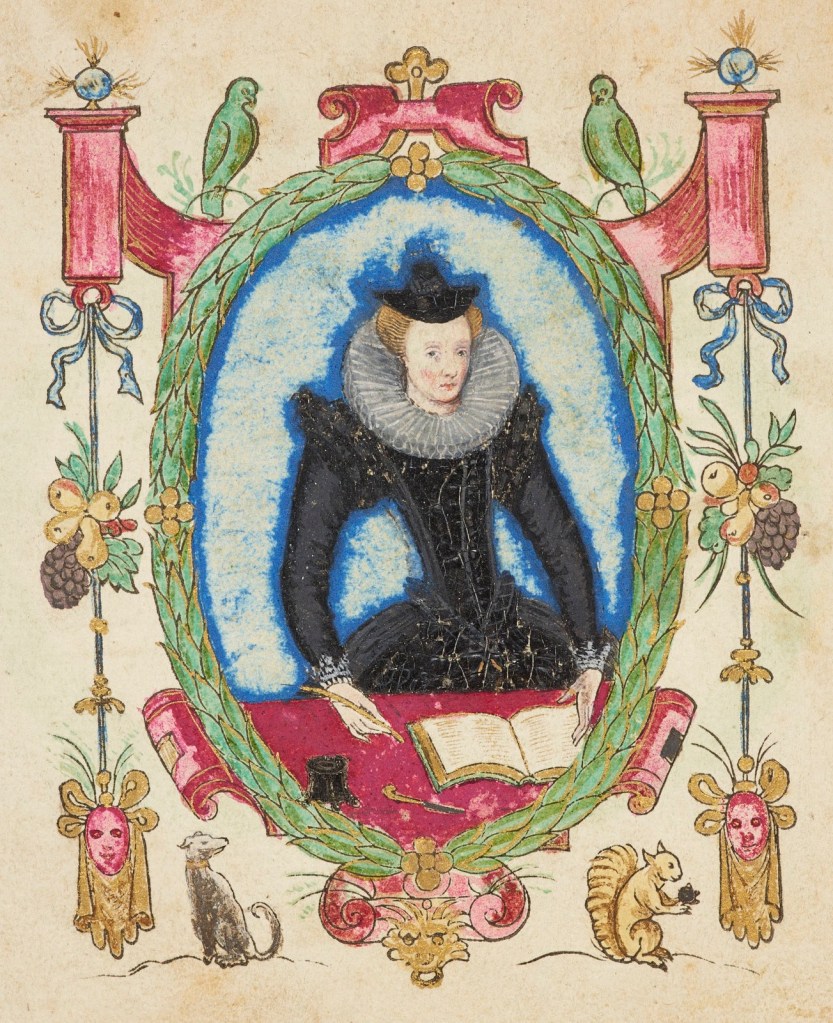
 Like Hemessen, Esther shows herself at work with the tools of her trade: pen, ink, and paper. Schurman never shows her hands actually creating. Apparently she was taken to task for that by Constantijn Huygens, the statesman and poet, who thought she should be proud of her ink-stained hands.4

Esther Inglis, Self portrait drawn with pen and ink, 1602 (NLS MS 20498); Schurman, Engraved self portrait, 1640 (NMWA, National Museum of Women in the Arts, Gift of Wallace and Wilhelmina Holladay)

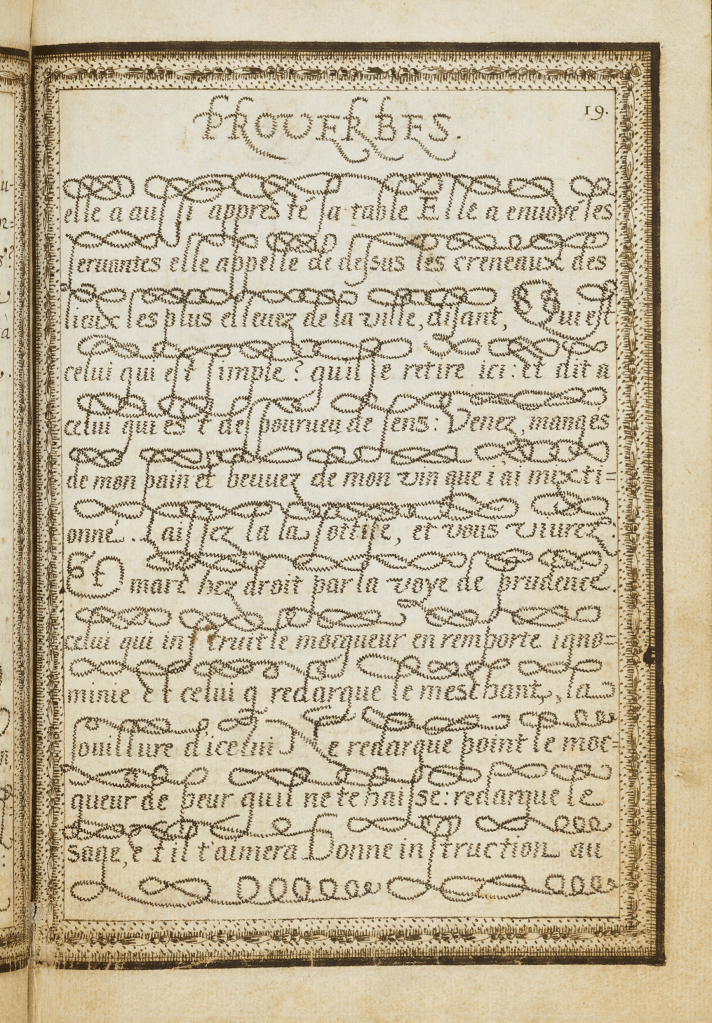
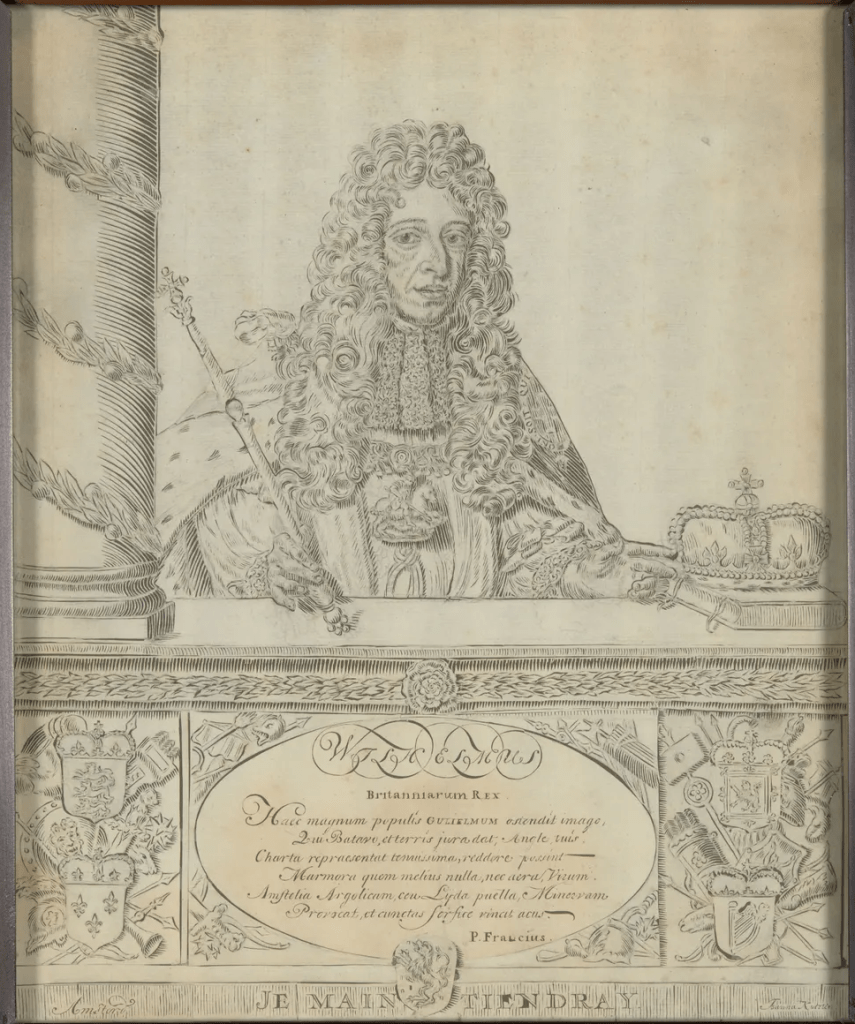
As we saw with Godewijck, some of these women were praised for embroidering with such skill that it looked like painting. Several handwriting styles used by Esther make the letters look as though they were stitched to the page. Similarly, the amazingly fine cut-paper work created by several of these artists, most especially Johanna Koerten (1650-1715), achieves the effect of pen-and-ink drawing produced by Esther and others of these Dutch artists.

Esther Inglis, Proverbes de Salomon, 1599. Bodleian Library MS 990.
Johanna Koerten, Paper cutting of William III c.1700, Museum De Lakenhal, Leiden

As a Franco-Scot, Esther Inglis was herself of continental origin, part of that wave of talented immigrants who poured into England and Scotland during the Protestant Reformation. Artists, goldsmiths, jewelers, calligraphers, printers, engravers, weavers—men and women—they enriched British society in the sixteenth and seventeenth centuries with their artistic contributions. To find Esther’s female peers, we do well to look to France and the Netherlands.


  1. On Segar see Susan Frye, Pens and Needles: Women’s Textualities in Early Modern England (University of Pennsylvania Press, 2010). ↩︎
  2. Unforgettable: Women Artists from Antwerp to Amsterdam, 1600-1750, ed. Virginia Treanor and Frederica Van Dam (Ghent: Hannibal Books, 2025). ↩︎
  3. Treanor, p.27. ↩︎
  4. NMWA website: https://nmwa.org/art/collection/schurman-self-portrait/ ↩︎

Esther Inglis and “Little Beasts”

The National Gallery of Art in Washington DC has recently opened an exhibition titled “Little Beasts; Art, Wonder, and the Natural World.” I had my first slow walk-through yesterday and plan to return – maybe more than once!

It’s a small but marvelous exhibition focusing on sixteenth and seventeenth-century artists from the Netherlands who became passionate and detailed observers of the natural world, especially butterflies, moths, shells, and insects, but also larger animals, often strange ones from foreign shores. As the Dutch developed an extensive mercantile trade, they came into contact with new and exotic objects, often obtained for them by the efforts of the native peoples in the countries they visited, many in South Asia.

Joris Hoefnagel, Plate XXII from The Four Elements, c.1575-1590s. Watercolour and gold paint on parchment. NGA, Washington. Gift of Mrs. Lessing J. Rosenwald.

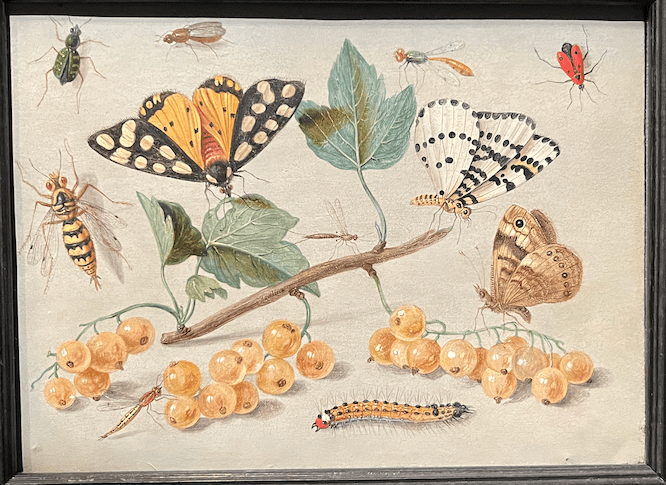
First focusing on Joris Hoefnagel (1542-1600), the exhibition details his working methods, and displays amazing examples from his watercolour series, “The Four Elements.” Then it moves on to his later counterpart, Jan van Kessel (1626-1679) who continued Hoefnagel’s studies in oil on copper. The NGA smartly partnered with the Smithsonian Museum of Natural HIstory to borrow specimens of actual animals, insects, and shells, shown alongside the artistic representations.

Jan van Kessel the Elder, Butterfly and Insects, c. 1655, oil on copper. NGA, Washington. Gift of John Dimick.

As soon as I walked in, I thought of Esther Inglis who used the same kinds of pigments as Hoefnagel – powdered red, green, and blue from natural sources mixed in shells – and similar brushes, samples of which are on display.

And Esther’s constant pairing of biblical and moral texts with her flowers, butterflies, birds, and frogs puts her in direct conversation with Hoefnagel and others at the time who “paired many drawings with Latin inscriptions of Bible verses, bits of poetry, mottos, or proverbs.” For them, the natural world was all a manifestation of God’s creation.

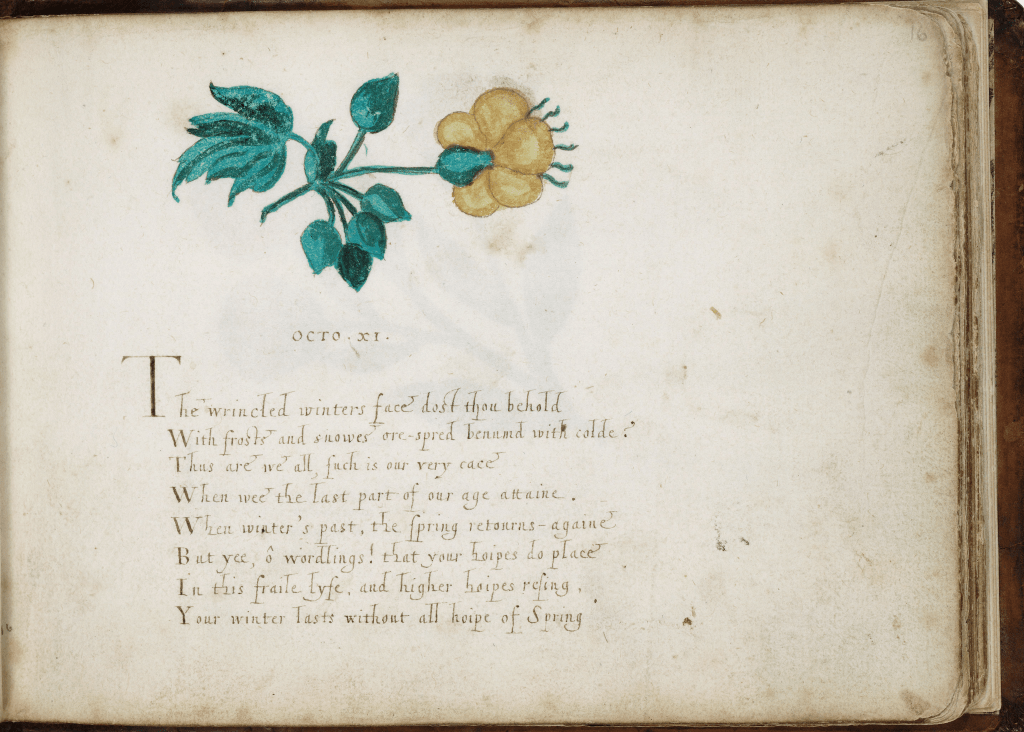
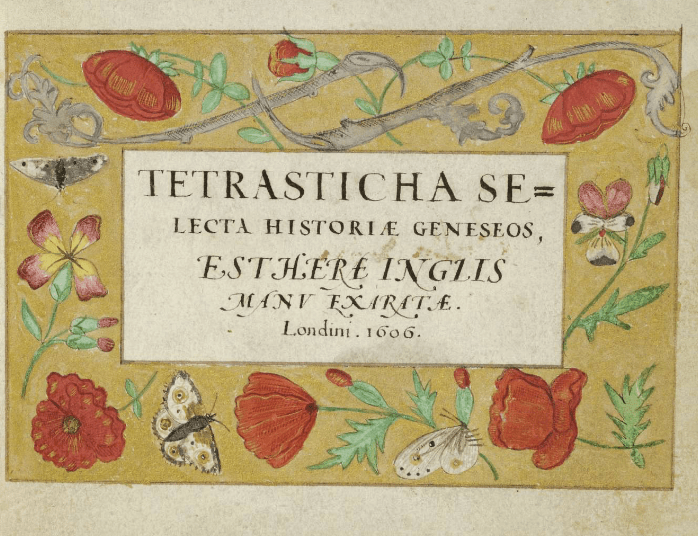
Esther Inglis, Argumenta Psalmorum, 1606. Houghton Library, MS Typ. 212
Esther Inglis, Argumenta Psalmorum, 1606. Houghton Library, MS Typ. 212 (cropped)

Flemish women artists were major contributors to floral works that often contained small insects, snails, or other creatures. An exquisite painting by Clara Peeters (c.1587-after 1636), features as the only work by a woman in the exhibition.

Clara Peeters, Still Life with Flowers surrounded by Insects and a Snail, c.1610. NGA, Washington. The Lee and Juliet Folger Fund.

She and Michaelina Wautier (c.1604-1689) were contemporaries of Esther Inglis, though Esther would not likely have seen their work. They were followed by Maria van Oosterwijck (1630-1693) and Rachel Ruysch (1664-1750) among others, plus the many women who painted with watercolour on paper, such as botanical artist Alida Withoos. For more about them, see the blog posts by Ariane van Suchtelen “Women and the Art of Flower Painting”, and by Catherine Powell, “Alida Withoos: Creator of beauty and of visual knowledge.”

We can assume that Esther Inglis would have enjoyed their company as she festooned her own works with flowers and critters from the same kinds of engravings copied by artists such as Hoefnagel and van Kessel. See my Folger blog: “Buds, Bugs, and Birds in the Manuscripts of Esther Inglis.”

“Little Beasts” is on through 2 November – go if you can, and check out their website for much more detail: https://www.nga.gov/exhibitions/little-beasts-art-wonder-and-natural-world

Celebrate Esther in April!

Staatsbibliothek, Berlin MS.Lat.C14

If you’re in Edinburgh, come enjoy a wonderful afternoon with interesting talks, delightful poetry, and great music.

Scottish novelist Sara Sheridan will be in conversation with historians Jamie Reid Baxter and Anna-Nadine Pike to illuminate the life and times of Franco-Scottish creative woman, Esther Inglis (1570?-1624). Writer, calligrapher, artist, embroiderer, she was the first woman in Britain to include self-portraits with her works.

RCIN MS 1047001

Then enjoy Scottish poet, Gerda Stevenson, as she reads works from Esther’s time, and some of her own poems featuring Esther.

Finally, hear The White Rose Ensemble perform music from Esther’s time, and contemporary music inspired by her work.

From Clément Perret, 1569 calligraphy manual used by Esther

Showtime! More Celebrations for Esther @400!

Late October saw the unveiling of two new exhibitions on Esther Inglis – one virtual and permanent at Edinburgh University Library, and the other actual at the Folger Shakespeare Library in Washington, DC, on view from October 25 through early February.

Design by Ruth Nichols-Pike, Edinburgh

The splendid online exhibition, Rewriting the Script: the Works and Words of Esther Inglis, was developed by Anna Nadine Pike at EUL. It brings together an amazing collection of images of Esther’s manuscripts, along with videos talking about some of them, and audio readings of others. It invites the visitor to dig more deeply into examining her self-portraits, her use of embroidery, the various kinds of script she wrote, her use of printed materials, and much more. It’s a fabulous site for students to explore, so be sure to pass them the link!

Case Designs by Studio A, Alexandria, Virginia. Photo by Heather Wolfe

“Little Books, Big Gifts: the Artistry of Esther Inglis” on display in Washington, DC combines manuscripts from the Folger Library and from Harvard’s Houghton Library. These two institutions together hold the largest number of her manuscripts in the US: 6 at the Folger and 8 at Harvard. Twelve of these are now on display, in addition to several facsimile pages.

Courtesy Folger Shakespeare Library, photo by Tim Tiebout

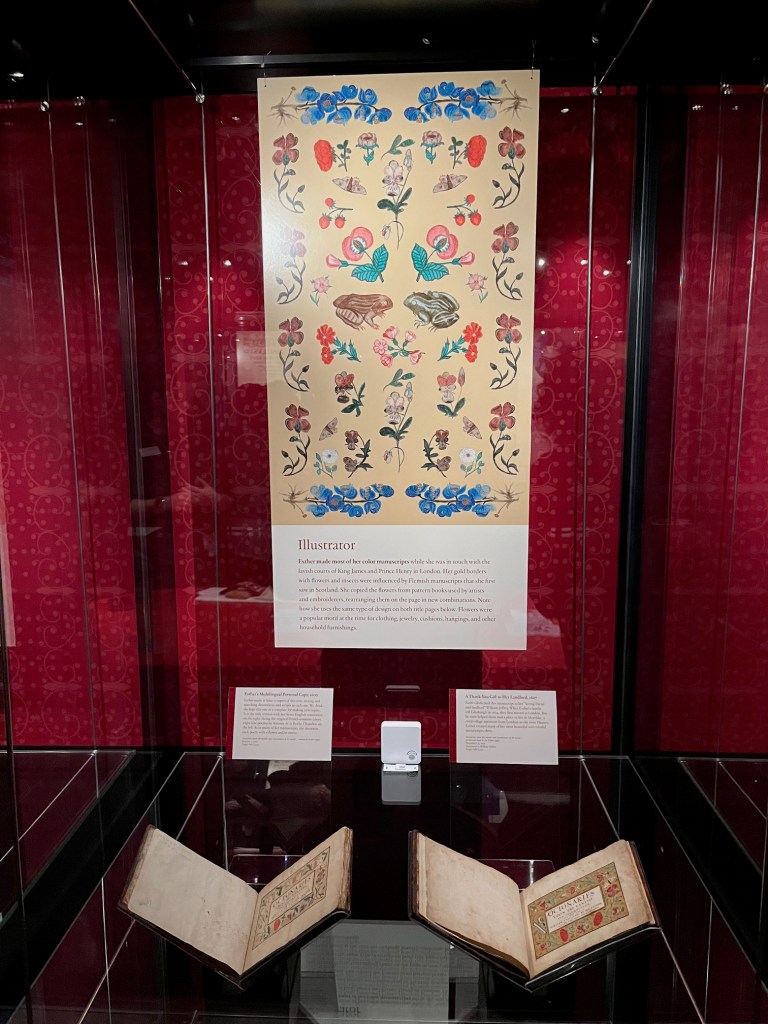
The exhibition creates a jewel-like setting for these beautiful books in cases titled: “Selfie Star”, “Gift Giver,” “Networker,” “Embroiderer,” “Illustrator,” and “Calligrapher.” It’s hard to realize how tiny some of these manuscripts are until you actually see them – no bigger than a matchbox. These seen below are two of the larger ones at 4.5 ” high and 6″ wide when closed.

“Illustrator” Case showing Folger MSS V.a.91 and V.a.92. Photo by G. Ziegler

The exhibition also features an exact reproduction of the embroidered binding Esther made for Folger MS V.a.93, a gift for Prince Maurice of Nassau in 1599. Professional embroiderers Christy Baty and Erin Moody painstakingly re-created the velvet and seed-pearl binding, while the Folger’s Conservation Lab made a tiny reproduction of the manuscript to size to fit into the binding. This manuscript is just under 4″ high and about 2.5″ wide when closed.

Reproduction of V.a.93 – text block on left. Photo by G. Ziegler

If you can’t make it in person, then enjoy the video about Esther’s “Selfies” here: https://www.youtube.com/watch?v=EK7QYU3YkaU and see a gallery of Esther’s manuscripts on the main exhibition page.  Want more? go to the page on this website for Locations of digitized manuscripts: https://estheringlis.com/ms-locations/ and enjoy!

Esther’s “selfies” used in Folger exhibition video. Photo from Folger website.

October is Esther Inglis Month!

Folger Library V.a.92, detail

20 October: Free Esther Inglis Concert at St. Cecilia’s

25 October: Little Books, Big Gifts: the Artistry of Esther Inglis, exhibition opening at the Folger Library in Washington, D.C. – includes 12 manuscripts, 6 from the Folger and 6 from Harvard – exhibition up through 19 January 2025 (more on this soon)

Ongoing: Exhibition at the National Library of Scotland including several Inglis manuscripts. Renaissance Scotland and Europe

Until 13 October: Now You See Us: Women Artists in Britain at Tate Britain. Includes two rarely-seen Inglis manuscripts from Christ Church Oxford and the Royal Collection.

September Red-Letter Days for Esther Inglis

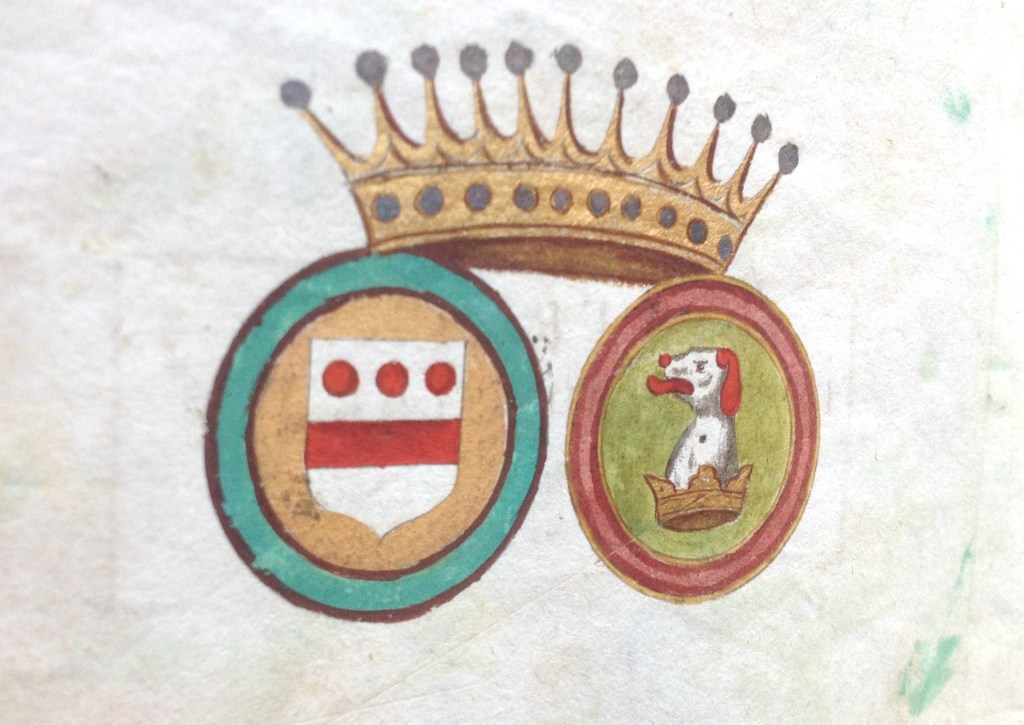
Arms of Robert, 3rd earl of Essex, Royal Library Copenhagen, MS Thott 323 – see more on this item below.

On 3 September 1574, the Edinburgh town council granted to Nicolas Langlois and Marie Presot, Esther’s parents, a ‘commodious house’, rent-free, for themselves and the new French school Nicolas was to run. He was to be paid an annual salary of £20 plus 25 shillings for every child enrolled. The couple were newly arrived in Edinburgh as Huguenot refugees, having spent a few years in London, and the town was expecting them. Their new ‘commodious house’ was “at the New Well,” the corner of Horse Wynd [now Guthrie St] and Cowgate. Esther was about four years old at the time.

Detail from William Edgar, Plan of the city and castle of Edinburgh, 1742 NLS The well is the little square at the top off Cowgate where it intersects with Horse Wynd.

For other September dates, we skip ahead to Esther’s years in and around London, where she and her husband Bartilmo Kello went in 1604, following King James VI who succeeded to the English crown in 1603. One of Esther’s early employments in London was making a copy of their friend David Hume of Godescroft’s De Unionis, part 2, at Hume’s request. The first part of Hume’s argument for a British union had just been published in 1605, and the issue was being debated in Parliament. Esther finished her good copy of Part 2 on 20 September 1605, when the letter “To the Reader” is dedicated. The second part was so politically “hot”, however, that it was not printed until modern times. The front is decorated with just one red rose and a bud.

David Hume of Godescroft, Vincula Unionis, written out by Esther Inglis, 1605. EUL La.III.249

The following year, in September 1606, Esther presented a copy of one of her favourite sets of moral verses, Pybrac’s Quatrains, to fifteen-year-old Robert Devereux, son of the disgraced Earl of Essex for whom Bartilmo had worked. Robert was rehabilitated by King James and educated with Prince Henry. He had just been forced into marriage with another teenager, Frances Howard. Since neither was ready for wedded life, it was suggested that Robert take a Grand Tour. Esther writes in her dedication: “Monseigneur, having heard of the departure of your Lordship out of this Realm, towards the country of France, and remembering how graciously Monseigneur your very illustrious father of eternal memory received the fruits of my pen, I have prepared to devise this little work which I present in all reverence to your Lordship, praying that the Eternal will watch over you, lead you, and make you return with joy.”

Esther’s dedication to “Robert Conte D’Essex”, in Royal Library Copenhagen, MS Thott 323

Finally on 15 September 1612, Esther gave Prince Henry a copy of the Psalmes of David in a lovely embroidered binding of flowers in a vase. In her lengthy dedication, she impresses upon the prince once again the importance of staying on the right path in life by reading the scriptures, and especially the Psalms. She describes her little book thus: “This heavenly ladder, upo[n] the which I have bestowed a simpel ornement the bettir to decoir [decorate] it, contayning the Spiritualle songs of the sweit singer of Israell is convenient to be takin in your Princlye hand and from ye hand to be layd up in your heart.” This is the last gift that Esther would give the prince, as he died on 6 November 1612.

Esther’s self-portrait in Psalmes dedicated “To the Most Excellent Hopfull and Peirlesse P. Henrie Prince of great Britaine.” Folger V.a.665

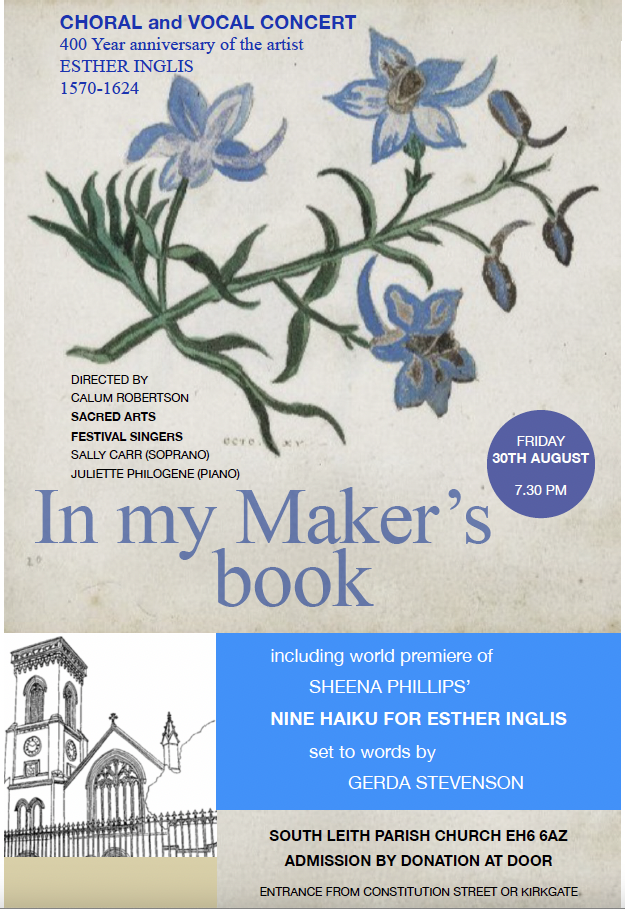
‘In my Maker’s book’: Concert in Memory of Esther Inglis – 30 August 2024

From the Lord goodness,
from myself nothing
. Till death
I will chart his praise.

All creation dwells
in a leaf, bird, bloom or word
in my Maker's book.
Gerda Stevenson

Esther Inglis arrived in Leith aged three in 1574. Leith was also where she died on 30 August 1624. Her parents were French protestant refugees, who in November 1574 opened a French school, supported by Edinburgh town council. Born in Dieppe, Esther was a creator of beautiful, often miniature manuscripts. She was also a painter, a writer, a skilled embroiderer and the mother of at least seven children. Devoutly religious, she lived most of her life in Edinburgh and Leith. This unique concert in the splendid setting of South Leith Parish Church celebrates Esther and her astonishing handiwork in music and images.

The centrepiece will be the world-première of Sheena Phillips’ brand-new Nine Haiku for Esther Inglis, which sets poems by acclaimed Scottish poet Gerda Stevenson, first published in her collection Quines: Poems in tribute to women of Scotland.  

As part of the concert, stunning images of Esther’s manuscripts will be screened. In addition to the Nine Haiku, vocal music of Esther’s time will be sung, including magnificent choral laments by Robert Ramsey for the death in 1612 of one of Esther’s patrons, Prince Henry Frederick Stuart, the eighteen-year old ‘Prince of Great Britain’. 

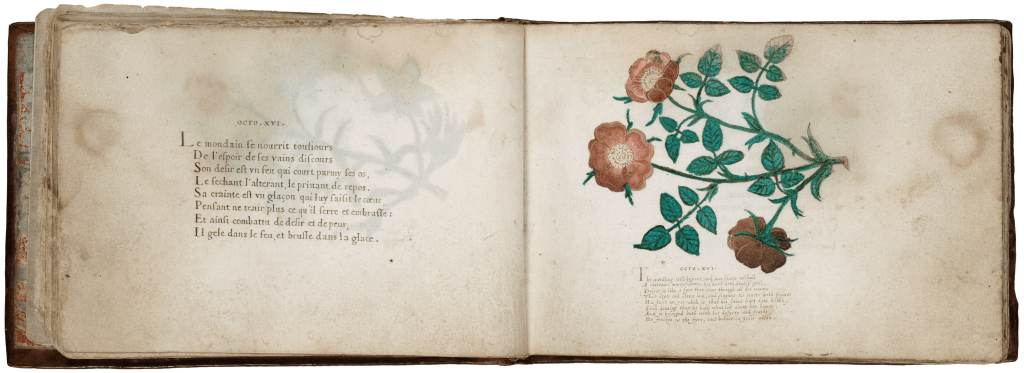
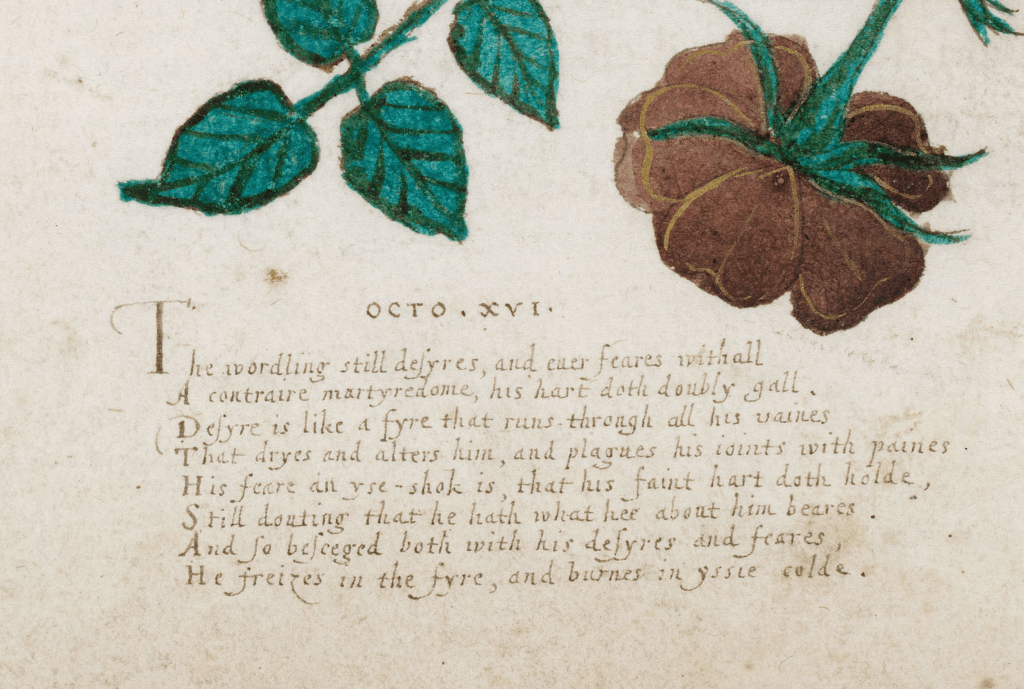
There will also be metrical psalms in Scots and French (these are for audience participation: tunes and texts will be provided!), and polyphonic settings of French poetic texts of which Esther Inglis repeatedly made exquisite manuscript copies: Claude Le Jeune’s settings of Antoine de Chandieu’s Octonaires sur la vanité et inconstance du monde, and Paschal de L’Estocart’s of the Quatrains du sieur de Pybrac.

The eight voices of the Sacred Arts Festival Chorus will be directed by Calum Robertson. Nine Haiku for Esther Inglis will be performed by Sally Carr (soprano), Juliette Philogene (piano) and Calum Robertson (clarinet and bass clarinet).

Entry is free, but donations to help cover costs are welcome.

South Leith Parish Church is in the Kirkgate, Leith, Edinburgh, EH6 6AZ.

 Link to map: https://nslpc.co.uk/about/

A Letter to the King

On 20 June 1620, Esther Inglis sat down to write a letter to King James. This is the only known letter from her that survives, and it gives a distinct sense of her straight-talking that we find in some of her manuscripts to the king as well as Princes Henry and Charles. The importance of the letter required her to use a large full sheet of paper – which was expensive – on which she writes her message in careful Roman script. The message barely takes up the top half of the sheet, but she signs it at the bottom right corner.

NLS Adv MS 33.1.6, Vol.20, no.21.

Addressing the king in large capitals at the top: ‘MOST MIGHTIE MONARCHE’, she gets right down to business. ‘Darre I presume vpon th’honnor and credit that I haue had at diuers tymes to speake your Royal Majesté and hath euer found your Highnes fauour’, indicating an extraordinary familiarity with the king, which indeed goes back to early days in Edinburgh. She is writing on behalf of her ‘only sonne who hauing past his course two yeares ago would glaidlie follow Theologie if it shall please God’. Samuel had taken his MA degree from the University of Edinburgh in 1618 but desired more study, so Esther is asking the king to write a letter on his behalf ‘to sum fellowship either in Cambridge or Oxefoord as occasion shall fall out’.

NLS Adv MS 33.1.6, Vol.20, no.21.

She has reminded King James that Samuel gave him a little book of his own poems when the king visited Edinburgh in 1617, and now she asks that he write a fellowship recommendation – rather like asking your favourite professor for a letter to go with your applications. Being fully aware of how the court operates, Esther spells out exactly what she wants done. When Samuel notifies one of the noblemen close to the king that he has a possible fellowship pending, let the nobleman tell the king’s secretary right away so that a letter can be expeditiously produced.

She ends, ‘For the which I may haue my tossed mynd releeued of the great cair I haue perpetuallie for this said youth. And wee all of vs will neuer cease to beseech God to preserue and prolong your Majesties lyfe with many happie & prosperous yeeres to Reigne ouer vs’. Esther reveals herself here as the caring mother, worried about the future for this her only remaining son who is so talented, and she assures the king that the whole family will be praying for him.

What an extraordinary letter from a middle-class woman to her ruler, not grovelling but honest and straightforward, harkening back to the openness of the Stewart court as it was in Scotland before 1603. Both she and Bartilmo had worked for the king in the 1590s, Samuel had met him twice in 1617, and Esther is here relying on this familiarity. In the end, after seven months, the king appointed Bartilmo to the living at Spexhall in Suffolk, but in fact it’s very unlikely that he ever went there.1 Samuel took that living within ten months, so his father’s appointment may have been a placeholder until Samuel finished his studies. He was to remain there for the rest of his life with his own family, dying at the ripe age of 84 in 1681. How proud his mother would have been.

  1. Thanks to Jamie Reid Baxter for this interpretation of the switch between father and son. ↩︎

“The boke of psalmes wreaten by my wife in French”

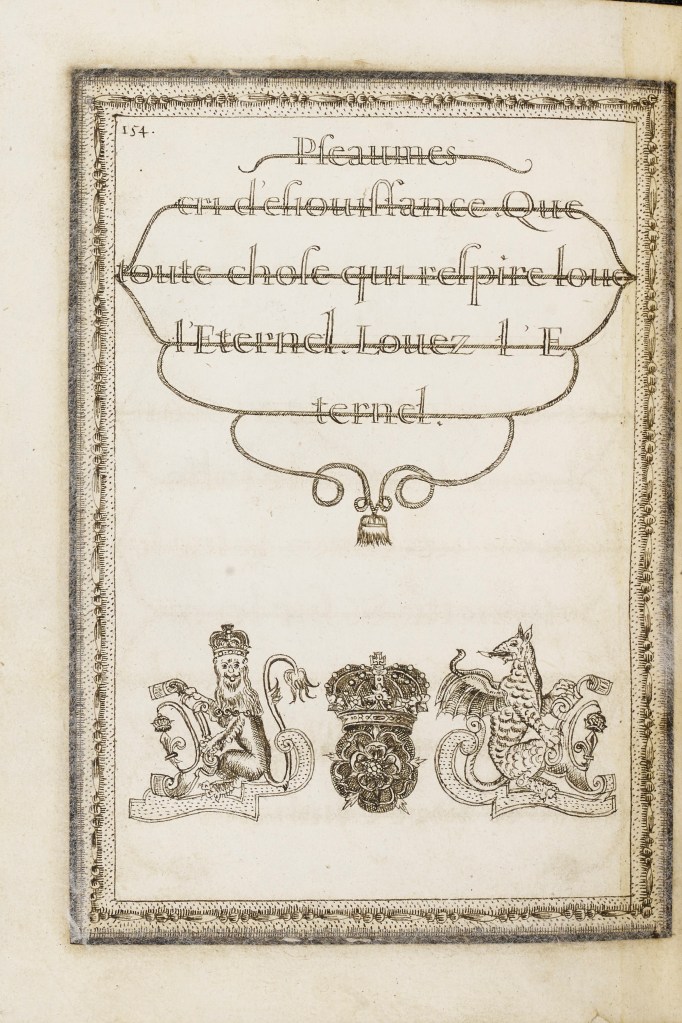
Sometime in the spring of 1599, Bartilmo Kello, Esther’s husband, travelled from Edinburgh down to London carrying messages for Queen Elizabeth I from James VI along with several manuscripts made by Esther. One of these was for the queen herself: a lovely book of Psalms in French, written out in a large variety of scripts, and decorated with bands of leafy and figurative designs in black and white, as well as Esther’s self-portrait. 

Bodleian, Christ Church Coll. Oxford MS 180, p.1

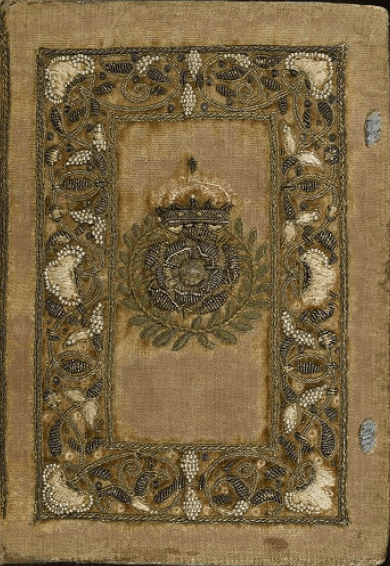
The binding of this little book displays a crowned Tudor rose embroidered front and back on red velvet, within a floral border picked out with seed pearls.  The rose motif is repeated again in ink line on the title page and at the end of the volume, while an elaborately-framed royal coat-of-arms is drawn on the verso of the title page. It is a stunning volume, which, according to a letter from Bartilmo, the Queen really liked. 

Bodleian, Christ Church Coll. MS 180 front cover

Bodleian, Christ Church Coll. MS 180, p.154

Esther dated her dedication as ‘De Lislebourg [Edinburgh] en Escosse, ce XXVII de Mars, 1599’. It’s an odd date, but represents the fact that she had to have this manuscript along with several others ready to go with Bartilmo. She signs the dedication in French as the queen’s ‘very humble, very affectionate, and very obedient servant forever’. 

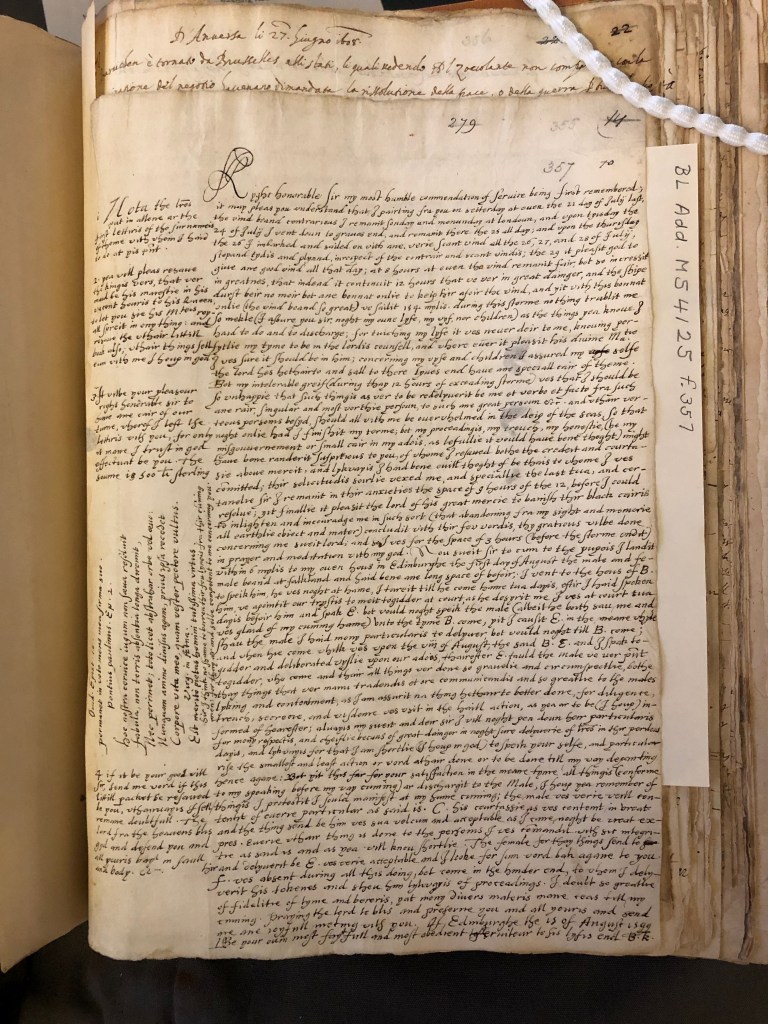
After finishing his duties in London, which included bringing manuscripts for Anthony Bacon and the Earl of Essex, for whom he was working, Bartilmo had to sit around and wait to be paid. This delay went on for so long that he wrote a letter to the queen, politely but firmly reminding her that she had approved of the manuscript but that he would like to get home.  Finally he made it back to Edinburgh in August, from where he wrote to Anthony Bacon about the terrible nine-hour storm they sailed into while going up the east coast of Scotland. 

Bartilmo’s letter to Anthony Bacon, BL Add MS 4125, f.357

 The Queen’s little volume now belongs to Christ Church College Oxford and is kept in the Bodleian Library, but it is also fully digitized here.  Enjoy!

Esther’s Children

Esther Inglis and Bartilmo Kello were married in 1596 and had at least eight children, possibly nine. Unlike many women of the period, Esther seems to have timed her pregnancies about every two years, which undoubtedly made it easier for her to work. Some of her whimsical moths, birds, caterpillars, and snails suggest she was aware of how her art could appeal to children as well.

Houghton Library MS Typ 212, 1606.

Esther’s ‘Very Hungry Caterpillar’! Houghton Library MS Typ 212, 1606.

Here is a list of the children of Esther and Bartilmo, with their baptismal dates.*

13 March 1597, Edinburgh: twins Samuel and Agnes; Agnes evidently died soon after as she disappears from the records; Samuel lived until 1680 as minister at Spexhall in Suffolk.

13 May 1599, Edinburgh: Jeane – she may have died young also as we don’t hear about her in the records. 

1 March 1601, Edinburgh: Josephe – died at age thirteen, 30 September 1614, Willingale Spain.

[no record ca. 1602], Edinburgh: Hester – marries James Crighton of Lochbank in 1618; they have six children.

8 March 1605, London: Isaake – died at age nine, 13 July 1614, Willingale Spain.

6 November 1608, Willingale-Spain: Elizabeth – appears in Edinburgh Registers of Sasines from 1620.

[7 April 1610, Willingale Spain: Margaret – father recorded as John Kello, but no other Kellos are found in that parish, so this may be a mistake by the registrar]

12 May 1612, Willingale Spain: Marie – marries Patrick Ainslie, merchant burgess of Edinburgh, December 1632 – he mistreats her.

*I am immensely grateful to Jamie Reid Baxter for trolling through many records to find these children.